


Page 707 - Hall et al (2015) Principles of Critical Care-McGraw-Hill
P. 707
526     PART 4: Pulmonary Disorders


                                            No further
                                           investigation;              Clinical features
                                                                       suggesting VAP
                                             observe       No
                                                                          Yes
                                                                  Obtain immediate endotracheal
                                                                    aspirate specimen before
                                                               starting or changing existing antibiotics


                                                                     Start empiric antibiotics
                                                                 immediately using ATS guidelines


                                                                          Positive    No      Stop
                                                                          cultures          antibiotics

                                                                          Yes
                                                                       Adjust antibiotics
                                                                     based on culture results
                                                                      and clinical response
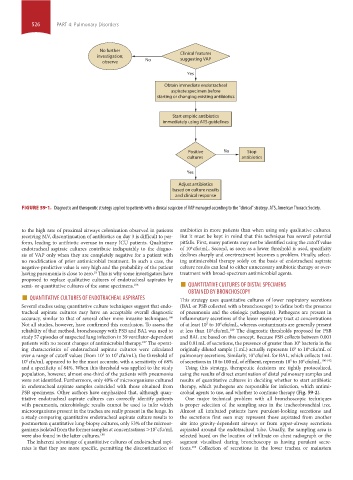
                 FIGURE 59-1.  Diagnostic and therapeutic strategy applied to patients with a clinical suspicion of VAP managed according to the “clinical” strategy. ATS, American Thoracic Society.


                 to the high rate of proximal airways colonization observed in patients   antibiotics in more patients than when using only qualitative cultures.
                 receiving MV, discontinuation of antibiotics on day 3 is difficult to per-  But it must be kept in mind that this technique has several potential
                 form, leading to antibiotic overuse in many ICU patients. Qualitative   pitfalls. First, many patients may not be identified using the cutoff value
                                                                           6
                 endotracheal aspirate cultures contribute indisputably to the diagno-  of 10  cfu/mL. Second, as soon as a lower threshold is used, specificity
                 sis of VAP only when they are completely negative for a patient with   declines sharply and overtreatment becomes a problem. Finally, select-
                 no modification of prior antimicrobial treatment. In such a case, the   ing antimicrobial therapy solely on the basis of endotracheal aspirate
                 negative-predictive value is very high and the probability of the patient   culture results can lead to either unnecessary antibiotic therapy or over-
                 having pneumonia is close to zero.  This is why some investigators have   treatment with broad-spectrum antimicrobial agents.
                                          18
                 proposed to replace qualitative cultures of endotracheal aspirates by     ■
                 semi- or quantitative cultures of the same specimens. 186  QUANTITATIVE CULTURES OF DISTAL SPECIMENS
                     ■  QUANTITATIVE CULTURES OF ENDOTRACHEAL ASPIRATES  This strategy uses quantitative cultures of lower respiratory secretions
                                                                          OBTAINED BY BRONCHOSCOPY
                 Several studies using quantitative culture techniques suggest that endo-  (BAL or PSB collected with a bronchoscope) to define both the presence
                 tracheal aspirate cultures may have an acceptable overall diagnostic   of pneumonia and the etiologic pathogen(s). Pathogens are present in
                 accuracy, similar to that of several other more invasive techniques.    inflammatory secretions of the lower respiratory tract at concentrations
                                                                   186
                 Not all studies, however, have confirmed this conclusion. To assess the   of at least 10  to 10  cfu/mL, whereas contaminants are generally present
                                                                                5
                                                                                     6
                 reliability of that method, bronchoscopy with PSB and BAL was used to   at less than 10  cfu/mL.  The diagnostic thresholds proposed for PSB
                                                                                        189
                                                                                  4
                 study 57 episodes of suspected lung infection in 39 ventilator-dependent   and BAL are based on this concept. Because PSB collects between 0.001
                 patients with no recent changes of antimicrobial therapy.  The operat-  and 0.01 mL of secretions, the presence of greater than 10  bacteria in the
                                                          187
                                                                                                                3
                 ing characteristics of endotracheal aspirate cultures were  calculated   originally diluted sample (1 mL) actually represents 10  to 10  cfu/mL of
                                                                                                              5
                                                                                                                   6
                 over a range of cutoff values (from 10  to 10  cfu/mL); the threshold of   pulmonary secretions. Similarly, 10  cfu/mL for BAL, which collects 1 mL
                                                  7
                                                                                                4
                                             3
                 10  cfu/mL appeared to be the most accurate, with a sensitivity of 68%   of secretions in 10 to 100 mL of effluent, represents 10  to 10  cfu/mL. 190-192
                                                                                                             5
                                                                                                                 6
                   6
                 and a specificity of 84%. When this threshold was applied to the study   Using  this  strategy,  therapeutic  decisions  are  tightly  protocolized,
                 population, however, almost one-third of the patients with pneumonia   using the results of direct examination of distal pulmonary samples and
                 were not identified. Furthermore, only 40% of microorganisms cultured   results of quantitative cultures in deciding whether to start antibiotic
                 in endotracheal aspirate samples coincided with those obtained from   therapy, which pathogens are responsible for infection, which antimi-
                 PSB specimens. Other authors have emphasized that, although quan-  crobial agents to use, and whether to continue therapy (Fig. 59-2).
                 titative endotracheal aspirate cultures can correctly identify patients   One major technical problem with all bronchoscopic techniques
                 with pneumonia, microbiologic results cannot be used to infer which   is proper selection of the sampling area in the tracheobronchial tree.
                 microorganisms present in the trachea are really present in the lungs. In   Almost  all intubated patients have purulent-looking secretions  and
                 a study comparing quantitative endotracheal aspirate culture results to   the secretions first seen may represent those aspirated from another
                 postmortem quantitative lung-biopsy cultures, only 53% of the microor-  site into gravity-dependent airways or from upper-airway secretions
                 ganisms isolated from the former samples at concentrations >10  cfu/mL     aspirated around the endotracheal tube. Usually, the sampling area is
                                                               7
                 were also found in the latter cultures. 188           selected based on the location of infiltrate on chest radiograph or the
                   The inherent advantage of quantitative cultures of endotracheal aspi-  segment visualized during bronchoscopy as having purulent secre-
                 rates is that they are more specific, permitting the discontinuation of   tions.  Collection of secretions in the lower trachea or mainstem
                                                                           193
            section04.indd   526                                                                                       1/23/2015   2:20:34 PM

