


Page 708 - Hall et al (2015) Principles of Critical Care-McGraw-Hill
P. 708
CHAPTER 59: Ventilator-Associated Pneumonia  527


                                                                          No further    No
                                                                          investigation;       Clinical features
                                                                                               suggesting VAP
                                                                           observe
                                                                                                 Yes
                                                                                         Immediate sampling of distal airways
                                                                                       by BAL/PSB before changing existing antibiotics


                                                                                               Direct specimen
                                                                                                examination


                        Observe,   No     Positive         Observe;  No       Signs of      No
                      look for another    quantitati     look for another      severe             Bacteria
                        infection(s)      vecultures      infection(s)         sepsis             present
                                                                                                 Yes
                                                                              Yes
                                          Yes
                                                                                                Start antibiotics
                                                                            Start antibiotics  immediately using
                                        Start antibiotics                  immediately using   direct specimen
                                          based on                           ATS guidelines   examination results
                                         culture results                                     and local epidemiology


                                                          Continue or adjust  No  Positive        Positive  No  Continue or adjust
                                                         antibiotics; look for  quantitati       quantitati     antibiotics; look for
                                                         another infection(s)  vecultures        vecultures     another infection(s)

                                                                              Yes                Yes
                                                                            Adjust antibiotics  Adjust antibiotics
                                                                          based on culture results  based on culture results

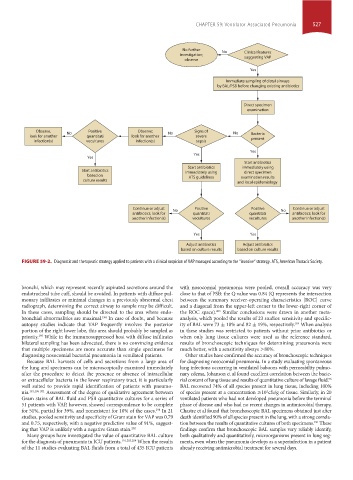
                    FIGURE 59-2.  Diagnostic and therapeutic strategy applied to patients with a clinical suspicion of VAP managed according to the “invasive” strategy. ATS, American Thoracic Society.


                    bronchi, which may represent recently aspirated secretions around the   with nosocomial pneumonia were pooled, overall accuracy was very
                    endotracheal tube cuff, should be avoided. In patients with diffuse pul-  close to that of PSB: the Q value was 0.84 (Q represents the intersection
                    monary infiltrates or minimal changes in a previously abnormal chest   between the summary receiver-operating characteristics [ROC] curve
                    radiograph, determining the correct airway to sample may be difficult.   and a diagonal from the upper-left corner to the lower-right corner of
                    In these cases, sampling should be directed to the area where endo-  the ROC space).  Similar conclusions were drawn in another meta-
                                                                                      203
                    bronchial abnormalities are maximal.  In case of doubt, and because   analysis, which pooled the results of 23 studies: sensitivity and specific-
                                               194
                    autopsy studies indicate that VAP frequently involves the posterior   ity of BAL were 73 ± 18% and 82 ± 19%, respectively.  When analysis
                                                                                                                 204
                    portion of the right lower lobe, this area should probably be sampled as   in these studies was restricted to patients without prior antibiotics or
                    priority.  While in the immunosuppressed host with diffuse infiltrates   when only lung tissue cultures were used as the reference standard,
                         195
                    bilateral sampling has been advocated, there is no convincing evidence   results of bronchoscopic techniques for determining pneumonia were
                    that multiple specimens are more accurate than single specimens for   much better, with a sensitivity always >80%.
                    diagnosing nosocomial bacterial pneumonia in ventilated patients.  Other studies have confirmed the accuracy of bronchoscopic techniques
                     Because BAL harvests of cells and secretions from a large area of   for diagnosing nosocomial pneumonia. In a study evaluating spontaneous
                    the lung and specimens can be microscopically examined immediately   lung infections occurring in ventilated baboons with permeability pulmo-
                    after the procedure to detect the presence or absence of intracellular   nary edema, Johanson et al found excellent correlation between the bacte-
                    or extracellular bacteria in the lower respiratory tract, it is particularly   rial content of lung tissue and results of quantitative culture of lavage fluid.
                                                                                                                            96
                    well suited to provide rapid identification of patients with pneumo-  BAL recovered 74% of all species present in lung tissue, including 100%
                    nia. 191,196-201  Assessment of the degree of qualitative agreement between   of species present at a concentration ≥10  cfu/g of tissue. Similarly, in 20
                                                                                                       4
                    Gram stains of BAL fluid and PSB quantitative cultures for a series of   ventilated patients who had not developed pneumonia before the terminal
                    51 patients with VAP, however, showed correspondence to be complete   phase of disease and who had no recent changes in antimicrobial therapy,
                    for 51%, partial for 39%, and nonexistent for 10% of the cases.  In 21   Chastre et al found that bronchoscopic BAL specimens obtained just after
                                                                 198
                    studies, pooled sensitivity and specificity of Gram stain for VAP was 0.79   death identified 90% of all species present in the lung, with a strong correla-
                    and 0.75, respectively, with a negative predictive value of 91%, suggest-  tion between the results of quantitative cultures of both specimens.  These
                                                                                                                       191
                    ing that VAP is unlikely with a negative Gram stain. 202  findings confirm that bronchoscopic BAL samples very reliably identify,
                     Many groups have investigated the value of quantitative BAL culture   both qualitatively and quantitatively, microorganisms present in lung seg-
                    for the diagnosis of pneumonia in ICU patients. 191,203,204  When the results   ments, even when the pneumonia develops as a superinfection in a patient
                    of the 11 studies evaluating BAL fluids from a total of 435 ICU patients   already receiving antimicrobial treatment for several days.


            section04.indd   527                                                                                       1/23/2015   2:20:35 PM

