


Page 827 - Hall et al (2015) Principles of Critical Care-McGraw-Hill
P. 827
558     PART 5: Infectious Disorders


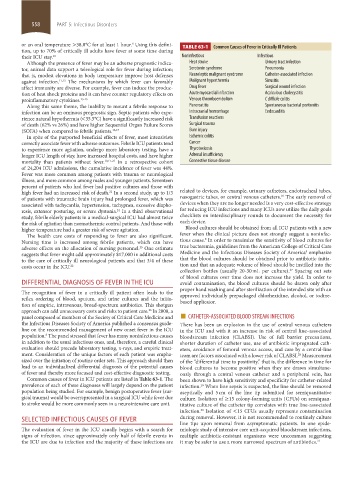
                 or an oral temperature >38.0°C for at least 1 hour.  Using this defini-    TABLE 63-1    Common Causes of Fever in Critically Ill Patients
                                                       8
                 tion, up to 70% of critically ill adults have fever at some time during
                 their ICU stay. 10                                     Noninfectious             Infectious
                   Although the presence of fever may be an adverse prognostic indica-  Heat stroke  Urinary tract infection
                 tor, animal data support a teleological role for fever during infection;   Serotonin syndrome  Pneumonia
                 that is, modest elevations in body temperature improve host defenses   Neuroleptic malignant syndrome  Catheter-associated infection
                 against  infection. 11,12   The  mechanisms  by  which  fever  can  favorably   Malignant hyperthermia  Sinusitis
                 affect immunity are diverse. For example, fever can induce the produc-  Drug fever  Surgical wound infection
                 tion of heat shock proteins and it can have counter regulatory effects on   Acute myocardial infarction  Acalculous cholecystitis
                 proinflammatory cytokines. 13-15                         Venous thromboembolism    C difficile colitis
                   Along this same theme, the inability to mount a febrile response to   Pancreatitis  Spontaneous bacterial peritonitis
                 infection can be an ominous prognostic sign. Septic patients who expe-  Intracranial hemorrhage  Endocarditis
                 rience natural hypothermia (<35.5°C) have a significantly increased risk   Transfusion reactions
                 of death (62% vs 26%) and have higher Sequential Organ Failure Scores   Surgical trauma
                 (SOFA) when compared to febrile patients. 16,17          Burn injury
                   In spite of the purported beneficial effects of fever, most intensivists   Ischemic colitis
                 correctly associate fever with adverse outcomes. Febrile ICU patients tend   Cancer
                 to experience more agitation, undergo more laboratory testing, have a   Thyrotoxicosis
                 longer ICU length of stay, have increased hospital costs, and have higher   Adrenal insufficiency
                 mortality  than  patients  without  fever. 10,17-23   In  a  retrospective  cohort   Connective tissue disease
                 of 24,204 ICU admissions, the cumulative incidence of fever was 44%.
                 Fever was more common among patients with trauma or neurological
                 illness, and more common among males and younger patients. Seventeen
                 percent of patients who had fever had positive cultures and those with
                 high fever had an increased risk of death.  In a second study, up to 1/3   related to devices, for example, urinary catheters, endotracheal tubes,
                                               21
                                                                                                          10
                 of patients with traumatic brain injury had prolonged fever, which was   nasogastric tubes, or central venous catheters.  The early removal of
                 associated with tachycardia, hypertension, tachypnea, excessive diapho-  devices when they are no longer needed is a very cost-effective strategy
                 resis, extensor posturing, or severe dystonia.  In a third observational   for reducing ICU infections and many ICUs now utilize the daily goals
                                                  24
                 study, febrile elderly patients in a medical-surgical ICU had almost twice   checklists on interdisciplinary rounds to document the necessity for
                 the risk of agitation than normothermic control patients. And those with   each device.
                 higher temperature had a greater risk of severe agitation.  Blood cultures should be obtained from all ICU patients with a new
                   The health care costs of responding to fever are also significant.   fever when the clinical picture does not strongly suggest a noninfec-
                                                                                8
                 Nursing time is increased among febrile patients, which can have   tious cause.  In order to maximize the sensitivity of blood cultures for
                 adverse effects on the allocation of nursing personnel.  One estimate   true bacteremia, guidelines from the American College of Critical Care
                                                         25
                                                                                                                  8
                 suggests that fever might add approximately $17,000 in additional costs   Medicine and the Infectious Diseases Society of America  emphasize
                 to the care of critically ill neurological patients and that 3/4 of these   that the blood cultures should be obtained prior to antibiotic initia-
                 costs occur in the ICU. 22                            tion and that an adequate volume of blood should be instilled into the
                                                                       collection bottles (usually 20-30 mL per culture).  Spacing out sets
                                                                                                             27
                                                                       of blood cultures over time does not increase the yield. In order to
                 DIFFERENTIAL DIAGNOSIS OF FEVER IN THE ICU            avoid contamination, the blood cultures should be drawn only after
                                                                       proper hand washing and after sterilization of the intended site with an
                 The recognition of fever in  a critically ill patient often leads to the   approved individually prepackaged chlorhexidine, alcohol, or iodine-
                 reflex ordering of blood, sputum, and urine cultures and the initia-  based applicator.
                 tion of empiric, intravenous, broad-spectrum antibiotics. This shotgun
                 approach can add unnecessary costs and risks to patient care.  In 2008, a     ■
                                                            26
                 panel composed of members of the Society of Critical Care Medicine and   CATHETER-ASSOCIATED BLOOD STREAM INFECTIONS
                 the Infectious Diseases Society of America published a consensus guide-  There has been an explosion in the use of central venous catheters
                 line on the recommended management of new onset fever in the ICU   in the ICU and with it an increase in risk of central line–associated
                 population.  The panel stressed that fever has many noninfectious causes     bloodstream infection (CLABSI). Use of full barrier precautions,
                         8
                 in addition to the usual infectious ones, and, therefore, a careful clinical   shorter duration of catheter use, use of antibiotic impregnated cath-
                 evaluation should precede laboratory testing, x-rays, and empiric treat-  eters, avoidance of femoral venous access, and care by a central-line
                 ment. Consideration of the unique factors of each patient was empha-  team are factors associated with a lower risk of CLABSI.  Measurement
                                                                                                               28
                 sized over the initiation of routine order sets. This approach should then   of the “differential time to positivity,” that is, the difference in time for
                 lead to an individualized differential diagnosis of the potential causes   blood cultures to become positive when they are drawn simultane-
                 of fever and thereby more focused and cost-effective diagnostic testing.  ously  through  a central  venous catheter  and  a  peripheral  vein,  has
                   Common causes of fever in ICU patients are listed in Table 63-1. The   been shown to have high sensitivity and specificity for catheter-related
                 prevalence of each of these diagnoses will largely depend on the patient   infection.  When line sepsis is suspected, the line should be removed
                                                                              29
                 population being studied. For example, benign postoperative fever (sur-  aseptically  and  5 cm of the line  tip submitted  for semiquantitative
                 gical trauma) would be overrepresented in a surgical ICU while fever due   culture. Isolation of ≥15 colony-forming units (CFUs) on semiquan-
                 to stroke would be more commonly seen in a neurointensive care unit.  titative culture of the catheter tip correlates with true line-associated
                                                                       infection.  Isolation of  <15 CFUs usually represents contamination
                                                                              30
                 SELECTED INFECTIOUS CAUSES OF FEVER                   during removal. However, it is not recommended to routinely culture
                                                                       line tips upon removal from asymptomatic patients. In one epide-
                 The evaluation of fever in the ICU usually begins with a search for   miologic study of intensive care unit-acquired bloodstream infections,
                 signs of infection, since approximately only half of febrile events in   multiple antibiotic-resistant organisms were uncommon suggesting
                 the ICU are due to infection and the majority of these infections are   it may be safer to use a more narrowed spectrum of antibiotics. 31


            section05_c61-73.indd   558                                                                                1/23/2015   12:47:19 PM

