


Page 826 - Hall et al (2015) Principles of Critical Care-McGraw-Hill
P. 826
CHAPTER 63: Persistent Fever  557


                     CHAPTER    Persistent Fever                          TEMPERATURE REGULATION AND MEASUREMENT
                      63        Gretchen Yandle                           Healthy, nonfasting, resting adults, closely regulate sublingual tem-
                                                                          perature between 33.2°C and 38.1°C.  There is normally a small normal
                                                                                                    2
                                Bennett P. deBoisblanc
                                                                          diurnal variation in temperature of approximately 0.5°C, which nadirs
                                                                          around 6 am and peaks around 4 pm.  This tight regulation occurs due
                                                                                                     3
                                                                          to continual adjustment of thermogenic and cooling processes. Eating,
                                                                          exercise, and sleep deprivation increase body temperature while fasting
                     KEY POINTS                                           reduces it.  Technically fever refers to an increase in the natural set point
                                                                                 4
                        • Fever occurs in more than 50% of patients at some time during their    for homeostatic temperature control while  hyperthermia refers to an
                      ICU stay.                                           uncontrolled elevation of body temperature.
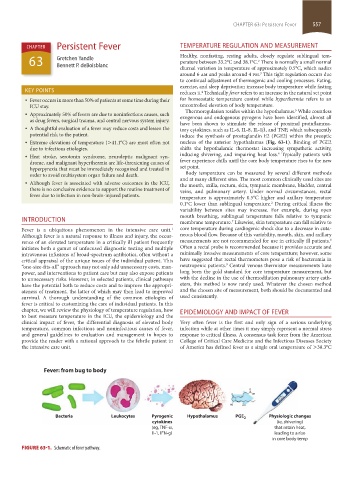
                                                                           Thermoregulation resides within the hypothalamus.  While countless
                                                                                                                 5
                        • Approximately 50% of fevers are due to noninfectious causes, such   exogenous and endogenous pyrogens have been identified, almost all
                      as drug fevers, surgical trauma, and central nervous system injury.  have been shown to stimulate the release of proximal proinflamma-
                        • A thoughtful evaluation of a fever may reduce costs and lessen the   tory cytokines, such as IL-6, IL-8, IL-1β, and TNF, which subsequently
                      potential risk to the patient.                      induce  the  synthesis  of  prostaglandin  E2  (PGE2)  within  the  preoptic
                        • Extreme elevations of temperature (>41.1°C) are most often not   nucleus of the anterior hypothalamus (Fig. 63-1). Binding of PGE2
                      due to infectious etiologies.                       shifts the hypothalamic thermostat increasing sympathetic activity,
                                                                                                           6
                        • Heat stroke, serotonin syndrome, neuroleptic malignant syn-  inducing shivering, and impairing heat loss.  Typically patients with
                      drome, and malignant hyperthermia are life-threatening causes of   fever experience chills until the core body temperature rises to the new
                      hyperpyrexia that must be immediately recognized and treated in   set point.
                                                                           Body temperature can be measured by several different methods
                      order to avoid multisystem organ failure and death.  and at many different sites. The most common clinically used sites are
                        • Although fever is associated with adverse outcomes in the ICU,   the mouth, axilla, rectum, skin, tympanic membrane, bladder, central
                      there is no conclusive evidence to support the routine treatment of   veins,  and pulmonary artery. Under normal circumstances, rectal
                      fever due to infection in non-brain-injured patients.  temperature  is  approximately  0.5°C  higher  and  axillary  temperature
                                                                          0.1°C lower than sublingual temperature.  During critical illness the
                                                                                                         2
                                                                          variability between sites may increase. For example, during open
                                                                          mouth breathing, sublingual temperature  falls relative to tympanic
                    INTRODUCTION                                          membrane  temperature.  Likewise, skin temperature can fall relative to
                                                                                           7
                                                                       1
                    Fever is a ubiquitous phenomenon in the intensive care unit.    core temperature during cardiogenic shock due to a decrease in cuta-
                    Although fever is a natural response to illness and injury, the occur-  neous blood flow. Because of this variability, mouth, skin, and axillary
                                                                                                                             8
                    rence of an elevated temperature in a critically ill patient frequently   measurements are not recommended for use in critically ill patients.
                    initiates both a gamut of unfocused diagnostic testing and multiple   Often a rectal probe is recommended because it provides accurate and
                    intravenous infusions of broad-spectrum antibiotics, often without a   minimally invasive measurements of core temperature; however, some
                    critical appraisal of the unique issues of the individual patient. This   have suggested that rectal thermometers pose a risk of bacteremia in
                                                                                         9
                    “one-size-fits-all” approach may not only add unnecessary costs, man-  neutropenic patients.  Central venous thermistor measurements have
                    power, and interventions to patient care but may also expose patients   long been the gold standard for core temperature measurement, but
                    to unnecessary risks. However, in selected patients, clinical pathways   with the decline in the use of thermodilution pulmonary artery cath-
                    have the potential both to reduce costs and to improve the appropri-  eters, this method is now rarely used. Whatever the chosen method
                    ateness of treatment, the latter of which may then lead to improved   and the chosen site of measurement, both should be documented and
                    survival. A thorough understanding of the common   etiologies of   used consistently.
                    fever is critical to customizing the care of individual patients. In this
                    chapter, we will review the physiology of temperature regulation, how   EPIDEMIOLOGY AND IMPACT OF FEVER
                    to best measure temperature in the ICU, the epidemiology and the
                    clinical impact of fever, the differential diagnosis of elevated body   Very often fever is the first and only sign of a serious underlying
                    temperature, common infectious and noninfectious causes of fever,   infection while at other times it may simply represent a normal stress
                    and  general guidelines  to  evaluation  and management in hopes to   response to critical illness. A consensus task force from the American
                    provide the reader with a rational approach to the febrile patient in   College of Critical Care Medicine and the Infectious Diseases Society
                    the intensive care unit.                              of America has defined fever as a single oral temperature of >38.3°C


                           Fever: from bug to body


                                                                                                 O
                                                                                           O      OH
                                                                                           HO  OH
                               Bacteria           Leukocytes    Pyrogenic   Hypothalamus    PGE 2       Physiologic changes
                                                                cytokines                                  (ie, shivering)
                                                                (eg, TNF- ,                               that retain heat,
                                                                Il-1, IFN-g)                              leading to a rise
                                                                                                         in core body temp
                    FIGURE 63-1.  Schematic of fever pathway.


            section05_c61-73.indd   557                                                                                1/23/2015   12:47:19 PM

