


Page 833 - Hall et al (2015) Principles of Critical Care-McGraw-Hill
P. 833
564     PART 5: Infectious Disorders


                 patients with cancer, diabetes, and HIV disease. 6,11,12  Remarkably, patients   T-cell stimulation.  Gram-negative bacteria, such as  Escherichia coli,
                                                                                     14
                 with cancer have among the highest population-adjusted rates for sepsis—  have a complex lipid called lipopolysaccharide (LPS) in its membrane
                 similarly high to that for patients with HIV and exceeding estimated rates   barrier, which activates the innate host immune response.  Similar to
                                                                                                                  15
                 with chronic lung disease, heart disease, and diabetes. 11  bacteria, viruses have a unique molecular pattern that is recognized
                   Sepsis incidence and mortality is also influenced by regional, seasonal,    and identified by various host Toll-like receptors (TLR). Additionally,
                 and cultural factors. Sepsis rates are lowest in the fall and highest in   an  immunosuppressed  host  can  fall  prey  to  fungal  infections  such  as
                 the winter, with the greatest increase in cases due to respiratory infec-  Candida albicans, an opportunistic pathogen that develops as a con-
                 tion.  Regional  differences  in  sepsis  incidence  are  also  apparent,  with   sequence of an inadequate immune host response. It is able to display
                 higher rates in the Northeastern United States and the greatest seasonal   various morphologies from a unicellular form (eg, hyphae, pseudohy-
                 changes in rates between the fall and winter seasons also seen in the   phae, or chlamydospores) and can threaten an altered immune host.
                                                                                                                          16
                 Northeast.  Both the seasonal and regional variation may relate to   As mentioned above, sepsis can occur with any of these microorganisms
                         13
                 rates of viral infections, which closely track cases of respiratory sepsis.   and each may initiate a host immune response resulting in a complex
                 Infection and sepsis rates are affected by myriad factors in the develop-  inflammatory and coagulation cascade.
                 ing world, including climatic conditions, and although data outside of
                 well-developed nations are sparse, the frequency of infectious diseases   Host Immune Response:  The host’s response to an infection depends
                 makes sepsis a likely culprit for the leading cause of death worldwide.  on both the innate and acquired host immune system. Certain
                                                                       patients are more susceptible to sepsis due to their inability to mount
                                                                       a normal immune response. The first line of host defense is the epi-
                 PATHOPHYSIOLOGY                                       thelium where the pathogen can break through and enter the host.
                 Over  the  years,  a considerable  amount has  changed  in  the way  we   The  innate  and  acquired  immune  systems  orchestrate  their  various
                 think about sepsis pathophysiology. Initially considered a syndrome   roles in an attempt to eradicate the threatening pathogen.
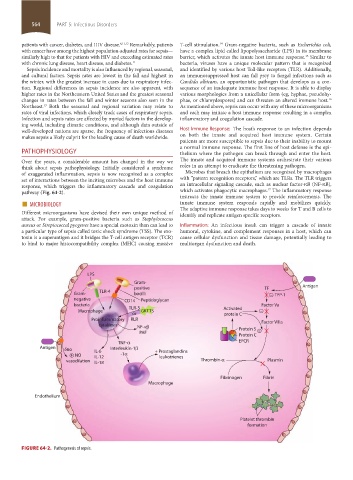
                 of exaggerated  inflammation, sepsis  is now recognized  as a complex   Microbes that breach the epithelium are recognized by macrophages
                 set of interactions between the inciting microbes and the host immune   with “pattern recognition receptors,” which are TLRs. The TLR triggers
                 response, which triggers the inflammatory cascade and coagulation   an intracellular signaling cascade, such as nuclear factor-κB (NF-κB),
                                                                                                     17
                 pathway (Fig. 64-2).                                  which activates phagocytic macrophages.  The inflammatory response
                     ■  MICROBIOLOGY                                   innate immune system responds rapidly and mobilizes quickly.
                                                                       instructs the innate immune system to provide reinforcements. The
                 Different microorganisms have devised their own unique method of   The adaptive immune response takes days to weeks for T and B cells to
                                                                       identify and replicate antigen specific receptors.
                 attack. For example, gram-positive bacteria such as  Staphylococcus
                 aureus or Streptococcal pyogenes have a special exotoxin than can lead to   Inflammation:  An infectious insult can trigger a cascade of innate
                 a particular type of sepsis called toxic shock syndrome (TSS). The exo-  humoral, cytokine, and complement responses in a host, which can
                 toxin is a superantigen and it bridges the T-cell antigen receptor (TCR)   cause cellular dysfunction and tissue damage, potentially leading to
                 to  bind  to  major  histocompatibility  complex  (MHC)  causing  massive   multiorgan dysfunction and death.


                                        LPS
                                                        Gram-
                                                        positive                                    TF           Antigen
                                   Gram-    TLR-4       bacilli                                       –  TFP-1
                                   negative         CD14  Peptidoglycan
                                   bacteria           TLR-3                                        Factor Va
                                    Macrophage            GKTTS                       Activated   –
                                                       or                             protein C
                                         Proinflammatory  RLR                                      Factor VIIIa
                                           cytokines     NF-
                                                         PAF                               Protein S  –
                                                                                           Protein C
                                                  TNF-                                     EPCR
                       Antigen                 Interleukin-1
                                 no       IL-6                 + Prostaglandins
                                  +  NO   IL-12    -1           leukotrienes
                                vasodilation  IL-18                           Thrombin-              Plasmin

                                                                                     Fibrinogen     Fibrin
                                                            Macrophage
                      Endothelium


                                                                                            Platelet thrombin
                                                                                              formation


                 FIGURE 64-2.  Pathogenesis of sepsis.


            section05_c61-73.indd   564                                                                                1/23/2015   12:47:49 PM

