


Page 837 - Hall et al (2015) Principles of Critical Care-McGraw-Hill
P. 837
568     PART 5: Infectious Disorders


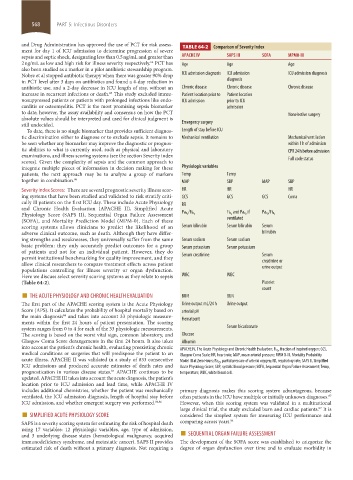
                 and Drug Administration has approved the use of PCT for risk assess-    TABLE 64-2    Comparison of Severity Index
                 ment for day 1 of ICU admission to determine progression of severe
                 sepsis and septic shock, designating less than 0.5 ng/mL and greater than   APACHE IV  SAPS III  SOFA  MPM0-III
                 2 ng/mL as low and high risk for illness severity respectively.  PCT has   Age  Age        Age
                                                             66
                 also been studied as a marker in a pilot antibiotic stewardship program.
                 Nobre et al stopped antibiotic therapy when there was greater 90% drop   ICU admission diagnosis  ICU admission   ICU admission diagnosis
                 in PCT level after 3 days on antibiotics and found a 4-day reduction in   diagnosis
                 antibiotic use, and a 2-day decrease in ICU length of stay, without an   Chronic disease  Chronic disease  Chronic disease
                 increase in recurrent infections or death.  This study excluded immu-  Patient location prior to   Patient location
                                               83
                 nosuppressed patients or patients with prolonged infections like endo-  ICU admission  prior to ICU
                 carditis or osteomyelitis. PCT is the most promising sepsis biomarker     admission
                 to date; however, the assay availability and consensus on how the PCT                      Nonelective surgery
                 absolute values should be interpreted and used for clinical judgment is
                 still undecided.                                       Emergency surgery
                   To date, there is no single biomarker that provides sufficient diagnos-  Length of stay before ICU
                 tic discrimination either to diagnose or to exclude sepsis. It remains to   Mechanical ventilation  Mechanical ventilation
                 be seen whether any biomarker may improve the diagnostic or prognos-                       within 1 h of admission
                 tic abilities to what is currently used, such as physical and laboratory                   CPR 24 h before admission
                 examinations, and illness scoring systems (see the section Severity index
                 scores). Given the complexity of sepsis and the common approach to                         Full code status
                 integrate multiple pieces of information in decision making for these   Physiologic variables
                 patients, the next approach may be to analyze a group of markers   Temp  Temp
                 together in combination. 66                            MAP            SBP         MAP      SBP
                 Severity Index Scores:  There are several prognostic severity illness scor-  HR  HR        HR
                 ing systems that have been studied and validated to risk stratify criti-  GCS  GCS  GCS    Coma
                 cally ill patients on the first ICU day. These include Acute Physiology   RR
                 and  Chronic  Health  Evaluation  (APACHE  II),  Simplified  Acute
                 Physiology Score (SAPS II), Sequential Organ Failure Assessment   Pa O 2 /Fi O 2  Fi O 2  and Pa O 2  if   Pa O 2 /Fi O 2
                 (SOFA),  and  Mortality  Prediction  Model  (MPM-0).  Each  of  these     ventilated
                 scoring systems allows clinicians to predict the likelihood of an   Serum bilirubin  Serum bilirubin  Serum
                 adverse clinical outcome, such as death. Although they have differ-               bilirubin
                 ing strengths and weaknesses, they universally suffer from the same   Serum sodium  Serum sodium
                 basic problem: they only accurately predict outcomes for a group   Serum potassium  Serum potassium
                 of patients and not for an individual patient. However, they do
                 permit institutional benchmarking for quality improvement, and they   Serum creatinine  Serum
                 allow clinical researchers to compare treatment effects across patient            creatinine or
                 populations  controlling  for  illness  severity  or  organ  dysfunction.         urine output
                 Here we discuss select severity scoring systems as they relate to sepsis   WBC  WBC
                 (Table 64-2).                                                                     Platelet
                     ■  THE ACUTE PHYSIOLOGY AND CHRONIC HEALTH EVALUATION  BUN        BUN         count

                 The first part of the APACHE scoring system is the Acute Physiology   Urine output mL/24 h  Urine output
                 Score (APS). It calculates the probability of hospital mortality based on   arterial pH
                 the main diagnosis  and takes into account 33 physiologic measure-  Hematocrit
                               84
                 ments  within  the  first  24  hours  of  patient  presentation.  The  scoring
                 system ranges from 0 to 4 for each of the 33 physiologic measurements.   Serum bicarbonate
                 The scoring is based on the worst vital sign, common laboratory, and   Glucose
                 Glasgow Coma Score derangements in the first 24 hours. It also takes   Albumin
                 into account the patient’s chronic health, evaluating preexisting chronic               , fraction of inspired oxygen; GCS,
                 medical conditions or surgeries that will predispose the patient to an   APACHE IV, The Acute Physiology and Chronic Health Evaluation; FiO 2
                                                                       Glasgow Coma Scale; HR, heart rate; MAP, mean arterial pressure; MPM O-III, Mortality Probability
                 acute illness. APACHE II was validated in a study of 833 consecutive   , partial pressure of arterial oxygen; RR, respiratory rate; SAPS II, Simplified
                 ICU admissions and produced accurate estimates of death rates and   Model III at Zero Hours; PaO 2
                                                                       Acute Physiology Score; SBP, systolic blood pressure; SOFA, Sequential Organ Failure Assessment; Temp,
                 prognostication in various disease states.  APACHE continues to be   temperature; WBC, white blood cell.
                                                85
                 updated. APACHE III takes into account the acute diagnosis, the patient’s
                 location prior to ICU admission and lead time, while APACHE IV
                 includes additional chemistries, whether the patient was mechanically   primary diagnosis makes this scoring system advantageous, because
                 ventilated, the ICU admission diagnosis, length of hospital stay before   often patients in the ICU have multiple or initially unknown diagnoses.
                                                                                                                          87
                 ICU admission, and whether emergent surgery was performed. 84,86  However, when this scoring system was validated in a multinational
                     ■  SIMPLIFIED ACUTE PHYSIOLOGY SCORE              large clinical trial, the study excluded burn and cardiac patients.  It is
                                                                                                                      87
                                                                       considered the simplest system for measuring ICU performance and
                 SAPS is a severity scoring system for estimating the risk of hospital death   comparing across years. 84
                 and 3 underlying disease states (hematological malignancy, acquired   ■  SEQUENTIAL ORGAN FAILURE ASSESSMENT
                 using 17 variables: 12 physiologic variables, age, type of admission,
                 immunodeficiency syndrome, and metastatic cancer). SAPS II provides   The development of the SOFA score was established to categorize the
                 estimated risk of death without a primary diagnosis. Not requiring a   degree of organ dysfunction over  time and to evaluate morbidity in


            section05_c61-73.indd   568                                                                                1/23/2015   12:47:50 PM

