


Page 832 - Hall et al (2015) Principles of Critical Care-McGraw-Hill
P. 832
CHAPTER 64: Sepsis, Severe Sepsis, and Septic Shock  563


                                                                          developed two new and important concepts. The first concept is that the
                      TABLE 64-1    Definition of Sepsis and Related Disorders
                                                                          SIRS criteria are only a few signs or symptoms that may indicate sepsis,
                    Disease State  Definition             Mortality       and while a new version of the SIRS criteria was not proposed, it was
                    Sepsis     Infection + at least two SIRS criteria  Determined by the   recognized that delaying a diagnosis of sepsis when the traditional four
                                                          underlying condition  SIRS criteria are absent is ultimately a disservice to an acute ill patient.
                                                                          Additional potential criteria were proposed, including heterogeneous
                    Severe sepsis  Sepsis with acute organ dysfunction  25%-40%
                                                                          clinical and laboratory manifestations of systemic illness (alterations
                    Septic shock  Sepsis with refractory hypotension despite    40%-80%  in mental status or hyperglycemia), infection (eg, elevated C-reactive
                               adequate fluid loading (vasoplegia)        protein or procalcitonin), and even sepsis-related organ dysfunction
                                                                          (central venous hypoxia, coagulopathy, oliguria, mottling). The second
                                                                          important concept put forth was the necessity to characterize the “stage”
                    trials and test new therapeutics. Although the ACCP/SCCM consen-  of illness for sepsis patients, as is done with cancer or heart disease. They
                    sus definition is imperfect, suffering from both a lack of sensitivity    proposed this as the PIRO model—Predisposition, Insult/Infection,
                    and specificity, it has transformed our understanding of sepsis epidemi-  Response, Organ dysfunction—which has since been validated as a tool
                    ology and pathogenesis, and it has permitted the successful testing of   for prognosticating outcomes with sepsis. 2-4
                    novel therapies for this condition.
                     An underlying principle of the ACCP/SCCM definition is that clini-    ■  MICROBIOLOGICAL CAUSES
                    cal sepsis represents the immune response to infection. That principle   Sepsis is classically considered a disease related to a gram-negative bac-
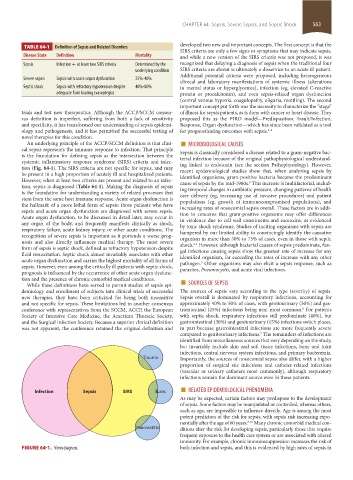
                    is the foundation for defining sepsis as the intersection between the   terial infection because of the original pathophysiological understand-
                    systemic inflammatory response syndrome (SIRS) criteria and infec-  ing linked to endotoxin (see the section Pathophysiology). However,
                    tion (Fig. 64-1). The SIRS criteria are not specific for sepsis, and may   recent epidemiological studies show that, when analyzing sepsis by
                    be present in a high proportion of acutely ill and hospitalized patients.   identified organisms, gram-positive bacteria became the predominant
                    However, when at least two criteria are present and related to an infec-  cause of sepsis by the mid-1980s.  This increase is multifactorial, includ-
                                                                                                 5
                    tion, sepsis is diagnosed (Table 64-1). Making the diagnosis of sepsis   ing temporal changes in antibiotic pressure, changing patterns of health
                    is the foundation for understanding a variety of related processes that   care delivery (eg, increasing use of invasive procedures) and patient
                    stem from the same host immune response. Acute organ dysfunction is    populations  (eg,  growth  of  immunocompromised  populations),  and
                    the hallmark of a more lethal form of sepsis: those patients who have   increasing rates of nosocomial sepsis overall. These factors are in addi-
                    sepsis  and acute organ  dysfunction  are diagnosed with  severe  sepsis.   tion to concerns that gram-positive organisms may offer differences
                    Acute organ dysfunction, to be discussed in detail later, may occur in   in virulence due to cell wall constituents and exotoxins, as evidenced
                    any organ of the body, and frequently manifests clinically as shock,   by toxic shock syndrome. Studies of inciting organisms with sepsis are
                    respiratory failure, acute kidney injury, or other acute conditions. The   hampered by our limited ability to convincingly identify the causative
                    recognition of severe sepsis is important as it portends a worse prog-  organism in more than 50% to 75% of cases, even in those with septic
                    nosis  and  also  directly  influences  medical  therapy.  The  most  severe   shock.  However, although bacterial causes of sepsis predominate, fun-
                                                                              6,7
                    form of sepsis is septic shock, defined as refractory hypotension despite   gal infections causing sepsis show the greatest rate of increase for any
                    fluid resuscitation. Septic shock almost invariably associates with other   identified organism, far exceeding the rates of increase with any other
                    acute organ dysfunction and carries the highest mortality of all forms of   pathogen.  Other organisms may also elicit a sepsis response, such as
                                                                                 5
                    sepsis. However, even among the critically ill patients with septic shock,   parasites, Pneumocystis, and acute viral infections.
                    prognosis is influenced by the occurrence of other acute organ dysfunc-
                     While these definitions have served to permit studies of sepsis epi-  ■
                    tion and the presence of chronic comorbid medical conditions.  SOURCES OF SEPSIS
                    demiology and enrollment of subjects into clinical trials of successful   The sources of sepsis vary according to the type (severity) of sepsis.
                    new therapies, they have been criticized for being both insensitive   Sepsis overall is dominated by respiratory infections, accounting for
                    and not specific for sepsis. These limitations led to another consensus   approximately 40% to 50% of cases, with genitourinary (30%) and gas-
                    conference with representatives from the SCCM, ACCP, the European   trointestinal (25%) infections being next most common.  For patients
                                                                                                                   6
                    Society  of  Intensive  Care  Medicine,  the  American  Thoracic  Society,   with septic shock, respiratory infections still predominate (40%), but
                    and the Surgical Infection Society. Because a superior clinical definition   gastrointestinal (30%) and genitourinary (15%) infections switch places,
                    was not apparent, the conference retained the original definition and   in part because gastrointestinal infections are more frequently severe
                                                                          compared to genitourinary infections.  The remainders of infections are
                                                                                                     7
                                                                          identified from miscellaneous sources that vary depending on the study,
                                                                          but invariably include skin and soft tissue infections, bone and joint
                                                                          infections, central nervous system infections, and primary bacteremia.
                                                             Trauma       Importantly, the sources of nosocomial sepsis also differ, with a higher
                                                                          proportion of surgical site infections and catheter-related infections
                                                                          (vascular or urinary catheters most commonly), although respiratory
                                                                          infections remain the dominant source even in these patients.
                                                                 Burns ■
                        Infection        Sepsis       SIRS                  RELATED EPIDEMIOLOGICAL PHENOMENA
                                                                          As may be expected, certain factors may predispose to the development
                                                                          of sepsis. Some factors may be manipulated or controlled, whereas others,
                                                                          such as age, are impossible to influence directly. Age is among the most
                                                                          potent predictors of the risk for sepsis, with sepsis risk increasing expo-
                                                                          nentially after the age of 60 years. 8-10  Many chronic comorbid medical con-
                                                           Pancreatitis   ditions alter the risk for developing sepsis, particularly those that require
                                                                          frequent exposure to the health care system or are associated with altered
                                                                          immunity. For example, chronic immunosuppression increases the risk of
                    FIGURE 64-1.  Venn diagram.                           both infection and sepsis, and this is evidenced by high rates of sepsis in


            section05_c61-73.indd   563                                                                                1/23/2015   12:47:21 PM

