


Page 840 - Hall et al (2015) Principles of Critical Care-McGraw-Hill
P. 840
CHAPTER 64: Sepsis, Severe Sepsis, and Septic Shock  571


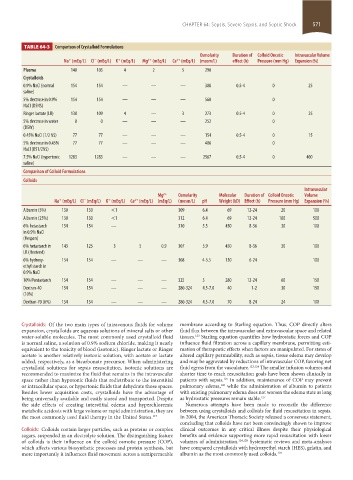
                      TABLE 64-3    Comparison of Crystalloid Formulations
                                                                                Osmolarity   Duration of  Colloid Oncotic   Intravascular Volume
                                            −
                                    +
                                  Na  (mEq/L) Cl  (mEq/L) K  (mEq/L)  Mg  (mEq/L)  Ca  (mEq/L) (mosm/L)  effect (h)  Pressure (mm Hg)  Expansion (%)
                                                                        2+
                                                               2+
                                                    +
                    Plasma          140      103      4         2         5       290
                    Crystalloids
                    0.9% NaCl (normal   154  154      —         —         —       308        0.5-4       0           25
                    saline)
                    5% dextrose in 0.9%   154  154    —         —         —       560                    0
                    NaCl (D5NS)
                    Ringer lactate (LR)  130  109     4         —         3       273        0.5-4       0           25
                    5% dextrose in water   0   0      —         —         —       252                    0
                    (D5W)
                    0.45% NaCl (1/2 NS)  77   77      —         —         —       154        0.5-4       0           15
                    5% dextrose in 0.45%   77  77     —         —         —       406                    0
                    NaCl (D51/2NS)
                    7.5% NaCl (hypertonic   1283  1283  —       —         —      2567        0.5-4       0           400
                    saline)
                    Comparison of Colloid Formulations
                    Colloids
                                                                                                                    Intravascular
                                                                    2+
                                                                  Mg     Osmolarity    Molecular   Duration of  Colloid Oncotic   Volume
                               Na  (mEq/L) Cl  (mEq/L) K  (mEq/L) Ca  (mEq/L) (mEq/L)  (mosm/L)  pH  Weight (kD) Effect (h)  Pressure (mm Hg) Expansion (%)
                                +
                                                          2+
                                                 +
                                         −
                    Albumin (5%)  130     130     <1                     309     6.4      69    12-24       20         100
                    Albumin (25%)  130    130     <1                     312     6.4      69    12-24      100         500
                    6% hetastarch   154   154     —                      310     5.5     450     8-36       30         100
                    in 0.9% NaCl
                    (Hespan)
                    6% hetastarch in   143  125    3        5      0.9   307     5.9     450     8-36       30         100
                    LR (Hextend)
                    6% hydroxy-  154      154     —        —       —     308     4-5.5   130     6-24                  100
                    ethyl starch in
                    0.9% NaCl
                    10% Pentastarch  154  154     —        —       —     325     5       280    12-24       60         150
                    Dextran-40   154      154     —        —       —     280-324  4.5-7.0  40     1-2       30         150
                    (10%)
                    Dextran-70 (6%)  154  154     —        —       —     280-324  4.5-7.0  70    8-24       24         100


                    Crystalloids:  Of the two main types of intravenous fluids for volume   membrane according to Starling equation. Thus, COP directly alters
                    expansion, crystalloids are aqueous solutions of mineral salts or other   fluid flux between the intravascular and extravascular space and related
                                                                               123
                    water-soluble molecules. The most commonly used crystalloid fluid   tissues.  Starling equation quantifies how hydrostatic forces and COP
                    is normal saline, a solution of 0.9% sodium chloride, making it nearly   influence fluid filtration across a capillary membrane, permitting esti-
                    equivalent to the tonicity of blood (isotonic). Ringer lactate or Ringer   mation of therapeutic effects when factors are manipulated. For states of
                    acetate is another relatively isotonic solution, with acetate or lactate   altered capillary permeability, such as sepsis, tissue edema may develop
                    added, respectively, as a bicarbonate precursor. When administering   and may be aggravated by reductions of intravascular COP, favoring net
                    crystalloid solutions for sepsis resuscitation, isotonic solutions are   fluid egress from the vasculature. 123,124  The smaller infusion volumes and
                    recommended to maximize the fluid that remains in the intravascular   shorter time to reach resuscitation goals have been shown clinically in
                    space rather than hypotonic fluids that redistribute to the interstitial   patients with sepsis.  In addition, maintenance of COP may prevent
                                                                                        125
                    or intracellular space, or hypertonic fluids that dehydrate those spaces.   pulmonary edema,  while the administration of albumin to patients
                                                                                       126
                    Besides lower acquisition costs, crystalloids have the advantage of   with existing pulmonary edema does not worsen the edema state as long
                    being universally available and easily stored and transported. Despite   as hydrostatic pressures remain stable. 127
                    the side effects of creating interstitial edema and hyperchloremic   Numerous  attempts  have  been  made  to  reconcile  the  difference
                    metabolic acidosis with large volume or rapid administration, they are   between using crystalloids and colloids for fluid resuscitation in sepsis.
                    the most commonly used fluid therapy in the United States. 117  In 2004, the American Thoracic Society released a consensus statement,
                                                                          concluding that colloids have not been convincingly shown to improve
                    Colloids:  Colloids contain larger particles, such as proteins or complex   clinical  outcomes  in  any critical  illness  despite  their  physiological
                    sugars, suspended in an electrolyte solution. The distinguishing feature   benefits and evidence supporting more rapid resuscitation with lower
                    of colloids is their influence on the colloid osmotic pressure (COP),   volumes of administration. 124,128  Systematic reviews and meta-analyses
                    which affects various biosynthetic processes and protein synthesis, but   have compared crystalloids with hydroxyethyl starch (HES), gelatin, and
                    more importantly it influences fluid movement across a semipermeable   albumin as the most commonly used colloids. 118


            section05_c61-73.indd   571                                                                                1/23/2015   12:47:51 PM

