


Page 841 - Hall et al (2015) Principles of Critical Care-McGraw-Hill
P. 841
572     PART 5: Infectious Disorders


                 Hetastarch and Gelatin:  Hetastarch (HES) and gelatin solutions are syn-  patients with septic shock, particularly those unresponsive to crystalloid
                 thetic colloids. HES solutions come in differing concentrations with   fluid  resuscitation. However,  additional  trials  are needed  in this  area
                 various molecular weights and hydroxyethyl groups. Although effective as   as well in order to delineate the optimal use for this fluid and the cost
                 resuscitative agents, HES solutions are known to induce a coagulopathy   effectiveness of this choice.
                 through effects on von Willebrand factor and factor VIII, potentially
                 shown to increase the risk of AKI in patients with severe sepsis and septic   ■  HEMODYNAMIC MANAGEMENT
                 increasing  the  risk  of  bleeding.   Recently,  HES  solutions  have  been
                                         129
                 shock. This was suggested in an early study  and convincingly shown in   Vasopressors:  Despite fluid resuscitation, there are occasions when
                                                130
                 the large VISEP trial where HES use caused a dose-dependent increase   vasopressor therapy is required to sustain life. Below a certain MAP,
                 in kidney injury and need for renal replacement therapy.  Gelatin-based   autoregulation of pressure in vascular beds can be lost and perfu-
                                                         131
                 colloid solutions are available in Europe and have similarly been associ-  sion becomes linearly dependent on pressure. 134,135  Currently, a
                 ated with coagulation defects, which may be less significant than with   MAP greater than or equal to 65 mm Hg has been recommended to
                                                                                             91
                     129
                 HES.  Because of these data, HES is not recommended as an intravenous   maintain perfusion pressure.  Titration of norepinephrine to this
                 colloid. The most common adverse effect of either colloid is an allergic   pressure has been shown to preserve tissue perfusion in a small study
                                                                                  135
                 response, which may include anaphylaxis. 128          of 10 patients,  and increasing vasopressor dose to a higher MAP of
                                                                       85 mm Hg does not significantly affect metabolic parameters or renal
                 Albumin:  Albumin is a natural protein colloid and is the most frequently   function. 135,136  However, the baseline blood pressure of the individual
                                              118
                 prescribed colloid in the United States.  Studies comparing albumin   involved should also be considered. Individuals with chronic systemic
                 to crystalloid administration in sepsis have found that time to reach   arterial hypertension might require higher arterial pressures to main-
                                                                                                              223
                 resuscitation targets is reduced by more than one-third with isooncotic   tain tissue perfusion and reduce acute kidney injury,  and those with
                 albumin. 125,132  Whether albumin exerts beneficial effects through other   diseases associated with relative hypotension (eg, chronic hepatic fail-
                 biological mechanisms, being the most abundant extracellular anti-  ure) may appropriately be managed with a lower goal MAP. Therefore,
                 oxidant, inhibiting oxidative stress and adhesion molecule expression   care providers must always supplement arterial pressure with other
                 or altering vascular permeability remains to be seen.  From a clinical   measures of global tissue perfusion, such as Scv O 2 , tissue oximetry,
                                                        128
                 perspective, most applicable is the recent review specifically comparing   blood lactate levels, delayed capillary refill, and urine output. 91,135
                 albumin and crystalloids in 1977 patients with sepsis where the use of   Over the years, there has been a long-standing debate regarding the
                 albumin was associated with lower mortality.  In support of this meta-  optimal vasopressor choice in septic shock. Although these discussions
                                                  117
                 analysis  is  the  subset  of  patients  enrolled  into  the  large  saline  versus   are intellectually stimulating, it is important to remember that each cate-
                 albumin fluid evaluation (SAFE) study conducted in Australia and   cholamine agent has variable receptor-mediated effects and thus distinct
                           133
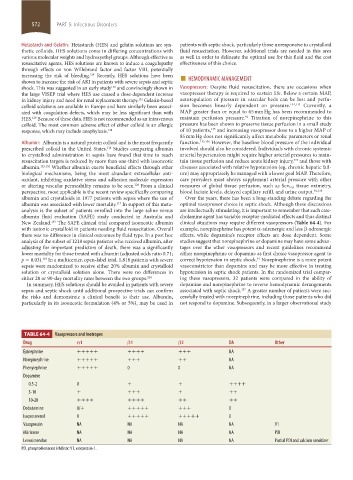
                 New Zealand.  The SAFE clinical trial compared isooncotic albumin   clinical situations may require different vasopressors (Table 64-4). For
                 with isotonic crystalloid in patients needing fluid resuscitation. Overall   example, norepinephrine has potent α-adrenergic and less β-adrenergic
                 there was no difference in clinical outcomes by fluid type. In a post hoc   effects, while dopamine’s receptor effects are dose dependent. Some
                 analysis of the subset of 1218 sepsis patients who received albumin, after   studies suggest that norepinephrine or dopamine may have some advan-
                 adjusting for important predictors of death, there was a significantly   tages over the other vasopressors and recent guidelines recommend
                 lower mortality for those treated with albumin (adjusted odds ratio 0.71;   either norepinephrine or dopamine as first choice vasopressor agent to
                 p = 0.03).  In a multicenter, open-label trial, 1,818 patients with severe   correct hypotension in septic shock.  Norepinephrine is a more potent
                                                                                                 91
                        119
                 sepsis were randomized to receive either 20% albumin and crystalloid   vasoconstrictor than dopamine and may be more effective in treating
                 solution or crystalloid solution alone. There were no differences in   hypotension in septic shock patients. In the randomized trial compar-
                 either 28 or 90-day mortality rates between the two groups. 224  ing these vasopressors, 32 patients were compared in the ability of
                   In summary, HES solutions should be avoided in patients with severe   dopamine and norepinephrine to reverse hemodynamic derangements
                 sepsis and septic shock until additional prospective trials can confirm   associated with septic shock.  A greater number of patients were suc-
                                                                                            137
                 the risks and demonstrate a clinical benefit to their use. Albumin,   cessfully treated with norepinephrine, including those patients who did
                 particularly in its isooncotic formulation (4% or 5%), may be used in   not respond to dopamine. Subsequently, in a larger observational study


                   TABLE 64-4    Vasopressors and Inotropes
                  Drug              α1               β1                β2               DA             Other
                  Epinephrine       +++++            ++++              +++              NA
                  Norepinephrine    +++++            +++               ++               NA
                  Phenylephrine     +++++            0                 0                NA
                  Dopamine
                    0.5-2           0                +                 +                ++++
                    3-10            +                +++               +                ++
                    10-20           ++++             ++++              ++               ++
                  Dobutamine        0/+              +++++             +++              0
                  Isoproterenol     0                +++++             +++++            0
                  Vasopressin       NA               NA                NA               NA             V1
                  Milrinone         NA               NA                NA               NA             PDI
                  Levosimendan      NA               NA                NA               NA             Partial PDI and calcium sensitizer
                 PDI, phosphodiesterase inhibitor; V1, vasopressin-1.


            section05_c61-73.indd   572                                                                                1/23/2015   12:47:51 PM

