


Page 843 - Hall et al (2015) Principles of Critical Care-McGraw-Hill
P. 843
574     PART 5: Infectious Disorders


                                                                       resting energy expenditure (kcal/d) using the Weir equation [1.44 (3.9
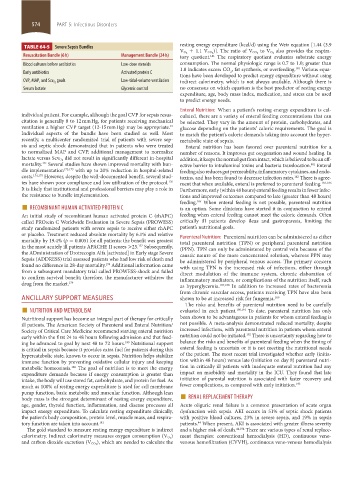
                   TABLE 64-5    Severe Sepsis Bundles
                                                                       V O 2   + 1.1 V CO 2 )]. The ratio of V CO 2  to V O 2  also provides the respira-
                  Resuscitation Bundle (6 h)       Management Bundle (24 h)  tory quotient.  The respiratory quotient evaluates substrate energy
                                                                                  181
                  Blood cultures before antibiotics  Low-dose steroids  consumption. The normal physiologic range is 0.7 to 1.0; greater than
                                                                       1.0 indicates excess CO , fat synthesis, or overfeeding.  Various equa-
                                                                                                               181
                  Early antibiotics                Activated protein C                  2
                                                                       tions have been developed to predict energy expenditure without using
                              goals                Low-tidal-volume ventilation  indirect calorimetry, which is not always available. Although there is
                  CVP, MAP, and Scv O 2
                  Serum lactate                    Glycemic control    no consensus on which equation is the best predictor of resting energy
                                                                       expenditure, age, body mass index, medication, and stress can be used
                                                                       to predict energy needs.
                                                                       Enteral Nutrition:  When a patient’s resting energy expenditure is cal-
                 individual patient. For example, although the goal CVP for sepsis resus-  culated, there are a variety of enteral feeding concentrations that can
                 citation is generally 8 to 12 mm Hg, for patients receiving mechanical   be selected. They vary in the amount of protein, carbohydrates, and
                                                                    91
                 ventilation a higher CVP target (12-15 mm Hg) may be appropriate.    glucose depending on the patients’ caloric requirements. The goal is
                 Individual aspects of the bundle have been studied as well. Most   to match the patient’s caloric demands taking into account the hyper-
                 recently, a  multicenter  randomized trial of  patients with  severe sep-  metabolic state of sepsis.
                 sis and septic shock demonstrated that in patients who were treated   Enteral nutrition has been favored over parenteral nutrition for a
                 to  normalized  MAP  and  CVP,  additional  management  to  normalize   number of reasons. It improves gut oxygenation and wound healing. In
                                did not result in significantly different in-hospital
                 lactate versus Scv O 2                                addition, it keeps the normal gut flora intact, which is believed to be an eff-
                        171
                 mortality.  Several studies have shown improved mortality with bun-  ective barrier to intraluminal toxins and bacteria translocation.  Enteral
                                                                                                                    182
                 dle implementation 172,173  with up to 20% reduction in hospital-related   feeding also reduces gut permeability, inflammatory cytokines, and endo-
                 costs. 174,175  However, despite the well-documented benefit, several stud-  toxins, and has been found to decrease infection rates.  There is agree-
                                                                                                              182
                 ies have shown poor compliance and low utilization of the protocol.    ment that when available, enteral is preferred to parenteral feeding. 183-186
                                                                   176
                 It is likely that institutional and professional barriers may play a role in   Furthermore, early (within 48 hours) enteral feeding results in fewer infec-
                 the resistance to bundle implementation.              tions and improved outcomes compared to late (greater than 48 hours)
                     ■  RECOMBINANT HUMAN ACTIVATED PROTEIN C          feeding.  When enteral feeding is not possible, parenteral nutrition
                                                                             186
                                                                       is an option. Some clinicians have started it in conjunction to enteral
                 An initial study of recombinant human activated protein C (rhAPC)   feeding when enteral feeding cannot meet the caloric demands. Often
                 called PROtein C Worldwide Evaluation in Severe Sepsis (PROWESS)   critically ill patients  develop ileus and gastroparesis, limiting the
                 study randomized patients with severe sepsis to receive either rhAPC   patient’s nutritional goals.
                 or placebo. Treatment reduced absolute mortality by 6.1% and relative   Parenteral Nutrition:  Parenteral nutrition can be administered as either
                 mortality by 19.4% (p = 0.005) for all patients; the benefit was greatest   total parenteral nutrition (TPN) or peripheral parenteral nutrition
                 in the most acutely ill patients APACHE II scores >25.  Subsequently,   (PPN). TPN can only be administered by central vein because of the
                                                         177
                 the ADministration of Drotrecogin Alfa [activated] in Early stage Severe   caustic nature of the more concentrated solution, whereas PPN may
                 Sepsis (ADDRESS) trial assessed patients who had low risk of death and   be administered by peripheral venous access. The primary concern
                 found no difference in 28-day mortality.  Additional information came   with using TPN is the increased risk of infections, either through
                                              178
                 from a subsequent mandatory trial called PROWESS-shock and failed   direct modulation of the immune system, chronic elaboration of
                 to confirm survival benefit; therefore, the manufacturer withdrew the   inflammatory mediators, or complications of the nutrition itself, such
                 drug from the market. 179                             as hyperglycemia. 187,188  In addition to increased rates of bacteremia
                                                                       from chronic vascular access, patients receiving TPN have also been
                 ANCILLARY SUPPORT MEASURES                            shown to be at increased risk for fungemia. 189
                     ■  NUTRITION AND METABOLISM                       evaluated in each patient. 190,191  To date, parenteral nutrition has only
                                                                         The risks and benefits of parenteral nutrition need to be carefully

                 Nutritional support has become an integral part of therapy for critically   been shown to be advantageous in patients for whom enteral feeding is
                 ill patients. The American Society of Parenteral and Enteral Nutrition/  not possible. A meta-analysis demonstrated reduced mortality, despite
                 Society of Critical Care Medicine recommend starting enteral nutrition   increased infections, with parenteral nutrition in patients whom enteral
                                                                                              192
                 early within the first 24 to 48 hours following admission and that feed-  nutrition could not be initiated.  There is uncertainty regarding how to
                                                    180
                 ing be advanced to goal by next 48 to 72 hours.  Nutritional support   balance the risks and benefits of parenteral feeding when the timing of
                 is critical in sepsis because it provides extra fuel for patients during this   enteral feeding is uncertain or it is not meeting the nutritional needs
                 hypercatabolic state, known to occur in sepsis. Nutrition helps stabilize   of the patient. The most recent trial investigated whether early (initia-
                 immune function by preventing oxidative cellular injury and keeping   tion within 48 hours) versus late (initiation on day 8) parenteral nutri-
                 metabolic homeostasis.  The goal of nutrition is to meet the energy   tion in critically ill patients with inadequate enteral nutrition had any
                                  180
                 expenditure demands because if energy consumption is greater than   impact on morbidity and mortality in the ICU. They found that late
                 intake, the body will use stored fat, carbohydrate, and protein for fuel. As   initiation of parental nutrition is associated with faster recovery and
                 much as 100% of resting energy expenditure is used for cell membrane   fewer complications, as compared with early initiation. 193
                 body mass is the strongest determinant of resting energy expenditure,   ■  RENAL REPLACEMENT THERAPY
                 pump function, basic metabolic and muscular function. Although lean
                 age, gender, thyroid function, inflammation, and disease processes all   Acute oliguric renal failure is a common presentation of acute organ
                 impact energy expenditure. To calculate resting expenditure clinically,   dysfunction  with  sepsis.  AKI  occurs  in  51%  of  septic  shock  patients
                 the patient’s body composition, protein level, muscle mass, and respira-  with positive blood cultures, 23% in severe sepsis, and 19% in sepsis
                 tory function are taken into account. 181             patients.  When present, AKI is associated with greater illness severity
                                                                             44
                   The gold standard to measure resting energy expenditure is indirect   and a higher risk of death. 44,194  There are various types of renal replace-
                                                                    )   ment  therapies:  conventional  hemodialysis  (HD),  continuous  veno-
                 calorimetry. Indirect calorimetry measures oxygen consumption (V O 2
                                           ), which are needed to calculate the   venous hemofiltration (CVVH), continuous veno-venous hemodialysis
                 and carbon dioxide excretion (V CO 2


            section05_c61-73.indd   574                                                                                1/23/2015   12:47:52 PM

