


Page 877 - Hall et al (2015) Principles of Critical Care-McGraw-Hill
P. 877
608     PART 5: Infectious Disorders


                 manifest only as febrile illness associated with an increased respiratory   rashes associated with specific drugs such as  β-lactam antibacterial
                 rate  and  a  few  localized  crepitations,  with  or  without  an  associated   drugs, allopurinol, or trimethoprim-sulfamethoxazole (TMP/SMX); and
                 cough or radiologic changes.  The clinician must search for additional   specific chemotherapy regimen–related rash syndromes (eg, the exfo-
                                      132
                 differential diagnostic clues such as the origin of the suspected pneu-  liative palmar/plantar syndrome associated with high-dose cytarabine;
                 monia (community or hospital acquired), the tempo of the illness, the   Fig. 68-4). These skin rash syndromes may coexist simultaneously.
                 association  of  the  illness  with  other  potentially noninfectious  factors   Once the relevant historical details and physical findings are established,
                 such as pulmonary edema, exposure to certain chemotherapeutic agents   the complete evaluation of the febrile neutropenic patient should include a
                 associated with lung injury (bleomycin, busulfan, cytarabine), radiation   series of laboratory and radiologic investigations designed to complement
                 therapy, pulmonary thromboemboli, pulmonary hemorrhage, or hyper-  the clinical examination. Specimens of body fluids such as blood, urine,
                 leukocytosis. Chest physical examination can do little to differentiate   cerebrospinal fluid, and lower respiratory secretions should be submitted to
                 infectious or noninfectious causes of pulmonary findings, but it can help   the clinical microbiology laboratory for culture and antimicrobial suscep-
                 identify the lower respiratory tract as the potential infected focus.  tibility testing where appropriate. At least two sets of blood cultures should
                   The symptoms and signs of an intra-abdominal infection may be   be obtained, one of which should be from a peripheral venous site. Further,
                 obvious or muted, focal, or diffuse. The most important finding is   it has been recommended that for patients with multilumen indwelling cen-
                 focal tenderness.  For example, tenderness in the right lower quadrant   tral venous catheters in situ, each lumen of the catheter should be sampled
                             130
                 might suggest neutropenic enterocolitis (typhlitis); right upper quadrant   in addition to blood from the peripheral venous site. 120,129
                 tenderness, a biliary tract focus or hepatomegaly; epigastric pain, an   The basic radiologic investigation is the chest radiograph. When
                 upper GI focus; and left lower quadrant tenderness, colitis or diverticu-  suggested by clinical clues, sinus radiographs are useful for detecting
                 lar disease. It is important to examine the perianal tissues for signs of   sinus opacification or fluid levels. Panorex radiographs can be help-
                 excoriation, local erythema, swelling, tenderness, fissure formation, or   ful for evaluating periodontal infection. High-resolution computed
                 hemorrhoidal tissues, since this area is frequently the site of major life-  tomographic (HRCT) examination of the lungs has a high yield of
                 threatening infection in neutropenic  patients.  Digital  examination of   abnormalities in febrile neutropenic patients despite nondiagnostic
                 the rectum is not recommended in neutropenic patients because of the   chest radiographs. 133,134  In one study, 60% of febrile neutropenic patients
                 additional risk of tissue damage, bleeding, and infection. A light perianal   with normal chest radiographs had a pulmonary infiltrate demonstrable
                 digital examination, however, can be informative about focal areas of   on the chest HRCT.  Computed tomography (CT) of the abdomen
                                                                                      133
                 cellulitis without increasing the risk of bacteremic infection.  or hepatic ultrasonography is valuable for assessing the significance of
                   Examination of the skin should consist of a thorough search for   abnormalities in cholestatic enzymes (γ-glutamyltransferase [GGT] and
                 focal areas of pain, swelling, or erythema, especially in association with   alkaline phosphatase). This is particularly important if the possibility of
                 indwelling vascular access devices. Particular attention should be paid   hepatosplenic candidiasis exists. Abdominal pain and tenderness with
                 to  the  venous  insertion,  tunnel,  and  exit sites  associated  with  central   diarrhea in a persistently febrile neutropenic patient suggests the possi-
                 venous catheters. In contrast, nonspecific local pocket tenderness may   bility of neutropenic enterocolitis. Abdominal CT looking for bowel wall
                 be the only clue to infection associated with the totally implantable   thickening, pneumatosis, wall nodularity, mucosal enhancement, bowel
                 venous access port-reservoir systems.                 dilation, ascites, and mesenteric stranding may be useful. 135
                 The differential diagnosis must include both infectious and noninfec-  ■  RISK ASSESSMENT
                   Skin rashes are a common phenomenon among neutropenic patients.
                 tious causes. Among the former group are focal ulcerative and necrotic   Neutropenia-related febrile episodes are heterogeneous with respect to
                 lesions caused by metastatic pyogenic bacterial infection such as that   the cause and duration of neutropenia, as well as fever risks and causes.
                 associated with bacteremic P aeruginosa or Staphylococcus aureus (infec-  Patients differ in their response to treatment and in their risks of com-
                 tions causing ecthyma gangrenosum), or by disseminated angioinvasive   plications. Accordingly, the practice standard has been to hospitalize all
                 filamentous fungi such as that due to Aspergillus species, Scedosporium   febrile neutropenic patients for assessment, empirical broad-spectrum
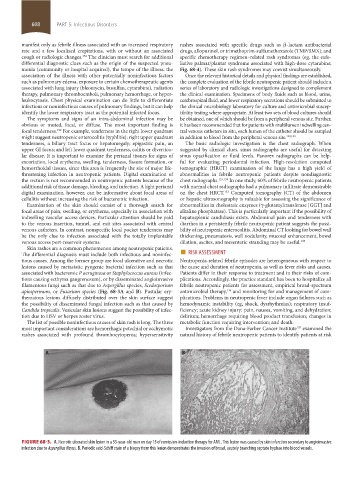
                 apiospermum, or  Fusarium species (Fig. 68-3A  and B). Pustular ery-  antimicrobial therapy,  and monitoring for and management of com-
                                                                                       136
                 thematous lesions diffusely distributed over the skin surface suggest   plications. Problems in neutropenic fever include organ failures such as
                 the possibility of disseminated fungal infection such as that caused by   hemodynamic instability (eg, shock, dysrhythmias); respiratory insuf-
                 Candida tropicalis. Vesicular skin lesions suggest the possibility of infec-  ficiency; acute kidney injury; pain, nausea, vomiting, and dehydration;
                 tion due to HSV or herpes zoster virus.               delirium; hemorrhage requiring blood product transfusion; changes in
                   The list of possible noninfectious causes of skin rash is long. The three   metabolic function requiring intervention; and death.
                 most important considerations are hemorrhagic petechial or ecchymotic   Investigators from the Dana-Farber Cancer Institute  examined the
                                                                                                               137
                 rashes associated with profound thrombocytopenia; hypersensitivity   natural history of febrile neutropenic patients to identify patients at risk

                         A                                              B


                 FIGURE 68-3.  A. Necrotic ulcerated skin lesion in a 53-year-old man on day 15 of remission-induction therapy for AML. This lesion was caused by skin infarction secondary to angioinvasive
                 infection due to Aspergillus flavus. B. Periodic acid-Schiff stain of a biopsy from this lesion demonstrates the invasion of broad, acutely branching septate hyphae into blood vessels.


            section05_c61-73.indd   608                                                                                1/23/2015   12:48:06 PM

