


Page 876 - Hall et al (2015) Principles of Critical Care-McGraw-Hill
P. 876
CHAPTER 68: Approach to Infection in Patients Receiving Cytotoxic Chemotherapy for Malignancy       607


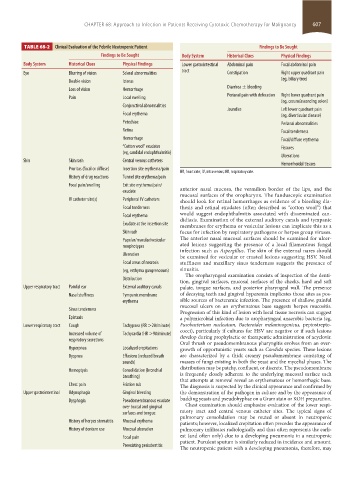
                      TABLE 68-2    Clinical Evaluation of the Febrile Neutropenic Patient           Findings to Be Sought
                                               Findings to Be Sought      Body System     Historical Clues  Physical Findings
                    Body System     Historical Clues  Physical Findings   Lower gastrointestinal   Abdominal pain  Focal abdominal pain
                    Eye             Blurring of vision  Scleral abnormalities  tract      Constipation      Right upper quadrant pain
                                                                                                            (eg, biliary tree)
                                    Double vision     Icterus
                                    Loss of vision    Hemorrhage                          Diarrhea ± bleeding
                                    Pain              Local swelling                      Perianal pain with defecation  Right lower quadrant pain
                                                                                                            (eg, cecum/ascending colon)
                                                      Conjunctival abnormalities
                                                                                          Jaundice          Left lower quadrant pain
                                                      Focal erythema                                        (eg, diverticular disease)
                                                      Petechiae                                             Perianal abnormalities
                                                      Retina                                                Focal tenderness
                                                      Hemorrhage                                            Focal/diffuse erythema
                                                      “Cotton wool” exudates                                Fissures
                                                      (eg, candidal endophthalmitis)
                                                                                                            Ulcerations
                    Skin            Skin rash         Central venous catheters
                                                                                                            Hemorrhoidal tissues
                                    Pruritus (focal or diffuse)  Insertion site erythema/pain
                                                                          HR, heart rate; IV, intravenous; RR, respiratory rate.
                                    History of drug reactions  Tunnel site erythema/pain
                                    Focal pain/swelling  Exit site erythema/pain/
                                                      exudate             anterior nasal mucosa, the vermilion border of the lips, and the
                                                                          mucosal surfaces of the oropharynx. The funduscopic examination
                                    IV catheter site(s)  Peripheral IV catheters  should look for retinal hemorrhages as evidence of a bleeding dia-
                                                      Focal tenderness    thesis and retinal exudates (often described as “cotton wool”) that
                                                      Focal erythema      would suggest endophthalmitis associated with disseminated can-
                                                                          didiasis. Examination of the external auditory canals and tympanic
                                                      Exudate at the insertion site  membranes for erythema or vesicular lesions can implicate this as a
                                                      Skin rash           focus for infection by respiratory pathogens or herpes group viruses.
                                                      Papular/macular/vesicular   The anterior nasal mucosal surfaces should be examined for ulcer-
                                                      morphotypes         ated  lesions  suggesting  the  presence  of  a  local  filamentous  fungal
                                                                          infection such as Aspergillus. The skin of the external nares should
                                                      Ulceration
                                                                          be examined for vesicular or crusted lesions suggesting HSV. Nasal
                                                      Focal areas of necrosis  stuffiness and maxillary sinus tenderness suggests the presence of
                                                      (eg, ecthyma gangrenosum)  sinusitis.
                                                                           The oropharyngeal examination consists of inspection of the denti-
                                                      Distribution
                                                                          tion, gingival surfaces, mucosal surfaces of the cheeks, hard and soft
                    Upper respiratory tract  Painful ear  External auditory canals  palate, tongue surfaces, and posterior pharyngeal wall. The presence
                                    Nasal stuffiness  Tympanic membrane    of decaying teeth and gingival hyperemia implicates those sites as pos-
                                                      erythema            sible sources of bacteremic infection. The presence of shallow, painful
                                                                          mucosal ulcers on an erythematous base suggests herpes mucositis.
                                    Sinus tenderness
                                                                          Progression of this kind of lesion with local tissue necrosis can suggest
                                    Epistaxis                             a polymicrobial infection due to oropharyngeal anaerobic bacteria (eg,
                    Lower respiratory tract  Cough    Tachypnea (RR >20/minute)  Fusobacterium nucleatum, Bacteroides melaninogenicus, peptostrepto-
                                                                          cocci), particularly if cultures for HSV are negative or if such lesions
                                    Increased volume of    Tachycardia (HR >90/minute)  develop during prophylactic or therapeutic administration of acyclovir.
                                    respiratory secretions
                                                                          Oral thrush or pseudomembranous pharyngitis evolves from an over-
                                    Hyperpnea         Localized crepitations  growth of opportunistic yeasts such as Candida species. These lesions
                                    Dyspnea           Effusions (reduced breath   are  characterized  by  a  thick  creamy  pseudomembrane  consisting  of
                                                      sounds)             masses of fungi existing in both the yeast and the mycelial phases. The
                                                                          distribution may be patchy, confluent, or discrete. The pseudomembrane
                                    Hemoptysis        Consolidation (bronchial   is frequently closely adherent to the underlying mucosal surface such
                                                      breathing)
                                                                          that attempts at removal reveal an erythematous or hemorrhagic base.
                                    Chest pain        Friction rub        The diagnosis is suspected by the clinical appearance and confirmed by
                    Upper gastrointestinal  Odynophagia  Gingival bleeding  the demonstration of the pathogen in culture and by the appearance of
                                    Dysphagia         Pseudomembranous exudate   budding yeasts and pseudohyphae on a Gram stain or KOH preparation.
                                                      over buccal and gingival    Chest examination should emphasize evaluation of the lower respi-
                                                      surfaces and tongue  ratory tract and central venous catheter sites. The typical signs of
                                                                          pulmonary consolidation may be muted or absent in neutropenic
                                    History of herpes stomatitis  Mucosal erythema  patients; however, localized crepitation often precedes the appearance of
                                    History of denture use  Mucosal ulceration  pulmonary infiltrates radiologically and thus often represents the earli-
                                                      Focal pain          est (and often only) clue to a developing pneumonia in a neutropenic
                                                                          patient. Purulent sputum is similarly reduced in incidence and amount.
                                                      Preexisting periodontitis
                                                                          The neutropenic patient with a developing pneumonia, therefore, may


            section05_c61-73.indd   607                                                                                1/23/2015   12:48:05 PM

