


Page 968 - Hall et al (2015) Principles of Critical Care-McGraw-Hill
P. 968
CHAPTER 75: Urinary Tract Infections  699


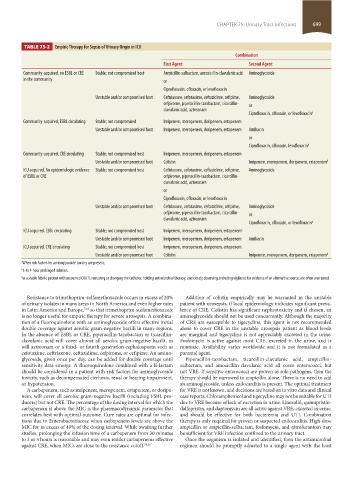
                      TABLE 75-2    Empiric Therapy for Sepsis of Urinary Origin in ICU
                                                                                            Combination
                                                                    First Agent                  Second Agent
                    Community-acquired, no ESBL or CRE    Stable; not compromised host  Ampicillin-sulbactam, amoxicillin-clavulanic acid  Aminoglycoside
                    in the community                                or
                                                                    Ciprofloxacin, ofloxacin, or levofloxacin
                                             Unstable and/or compromised host  Ceftriaxone, cefotaxime, ceftazidime, cefipime,   Aminoglycoside
                                                                      cefpirome, piperacillin-tazobactam, ticarcillin-   or
                                                                    clavulanic acid, aztreonam
                                                                                                 Ciprofloxacin, ofloxacin, or levofloxacin a
                    Community-acquired, ESBL circulating  Stable; not compromised  Imipenem, meropenem, doripenem, ertapenem
                                             Unstable and/or compromised host  Imipenem, meropenem, doripenem, ertapenem  Amikacin
                                                                                                 or
                                                                                                 Ciprofloxacin, ofloxacin, levofloxacin b
                    Community-acquired, CRE circulating  Stable; not compromised host  Imipenem, meropenem, doripenem, ertapenem
                                             Unstable and/or compromised host  Colistin          Imipenem, meropenem, doripenem, ertapenem b
                    ICU acquired. No epidemiologic evidence   Stable; not compromised host  Ceftriaxone, cefotaxime, ceftazidime, cefipime,   Aminoglycoside
                    of ESBL or CRE                                    cefpirome, piperacillin-tazobactam, ticarcillin-
                                                                    clavulanic acid, aztreonam
                                                                    or
                                                                    Ciprofloxacin, ofloxacin, or levofloxacin
                                             Unstable and/or compromised host  Ceftriaxone, cefotaxime, ceftazidime, cefipime,   Aminoglycoside
                                                                      cefpirome, piperacillin-tazobactam, ticarcillin-   or
                                                                    clavulanic acid, aztreonam
                                                                                                 Ciprofloxacin, ofloxacin, or levofloxacin a
                    ICU acquired. ESBL circulating  Stable; not compromised host  Imipenem, meropenem, doripenem, ertapenem c
                                             Unstable and/or compromised host  Imipenem, meropenem, doripenem, ertapenem  Amikacin
                    ICU acquired. CRE circulating  Stable; not compromised host  Imipenem, meropenem, doripenem, ertapenem
                                             Unstable and/or compromised host  Colistin          Imipenem, meropenem, doripenem, ertapenem b
                    a When risk factors for aminoglycoside toxicity are present.
                    b 3-to 4-hour prolonged infusion.
                    c In a stable febrile patient with presumed CAUTI, removing or changing the catheter, holding antimicrobial therapy, and closely observing, including vigilance for evidence of an alternative source, are often warranted.


                     Resistance to trimethoprim-sulfamethoxazole occurs in excess of 20%   Addition  of  colistin  empirically  may  be  warranted  in  the  unstable
                    of urinary isolates in many areas in North America and even higher rates   patient with urosepsis, if local epidemiology indicates significant preva-
                    in Latin America and Europe,  so that trimethoprim-sulfamethoxazole   lence of CRE. Colistin has significant nephrotoxicity and if chosen, an
                                         7,53
                    is no longer useful for empiric therapy for severe urosepsis. A combina-  aminoglycoside should not be used concurrently. Although the majority
                    tion of a fluoroquinolone with an aminoglycoside offers effective initial   of CRE are susceptible to tigecycline, this agent is not recommended
                    double coverage against aerobic gram-negative bacilli in many regions.   alone to cover CRE in the unstable urosepsis patient as blood levels
                    In the absence of ESBL or CRE, piperacillin-tazobactam or ticarcillin-  are marginal and tigecycline is not appreciably excreted in the urine.
                    clavulanic  acid  will  cover  almost  all  aerobic  gram-negative  bacilli,  as   Fosfomycin is active against most CRE, excreted in the urine, and is
                    will aztreonam or a third- or fourth-generation cephalosporin such as   nontoxic. Availability varies worldwide and it is not formulated as a
                    cefotaxime, ceftriaxone, ceftazidime, cefpirome, or cefipime. An amino-  parental agent.
                    glycoside, given once per day, can be added for double coverage until   Piperacillin-tazobactam,  ticarcillin-clavulanic  acid,  ampicillin-
                    sensitivity data emerge. A fluoroquinolone combined with a ß-lactam   sulbactam, and amoxicillin-clavulanic acid all cover enterococci, but
                    should be considered in a patient with risk factors for aminoglycoside   not VRE. If sensitive enterococci are proven as sole pathogens, then the
                    toxicity, such as decompensated cirrhosis, renal or hearing impairment,   therapy should be narrowed to ampicillin alone. There is no need to add
                    or hypotension.                                       an aminoglycoside, unless endocarditis is present. The optimal treatment
                     A carbapenem, such as imipenem, meropenem, ertapenem, or doripe-  for VRE is not known, and decisions are based on in vitro data and clinical
                    nem, will cover all aerobic gram-negative bacilli (including ESBL pro-  case reports. Chloramphenicol and tigecycline may not be suitable for UTI
                    ducers) but not CRE. The percentage of the dosing interval for which the   due to VRE because of lack of excretion in urine. Linezolid, quinupristin-
                    carbapenem is above the MIC is the pharmacodynamic parameter that   dalfopristin, and daptomycin are all active against VRE, excreted in urine,
                    correlates best with optimal outcome. Cure rates are optimal for infec-  and should be effective for both bacteremia and UTI. Combination
                    tions due to Enterobacteriaceae when carbapenem levels are above the   therapy is only required for proven or suspected endocarditis. High-dose
                    MIC for in excess of 40% of the dosing interval. While awaiting further   ampicillin or ampicillin-sulbactam, fosfomycin, and nitrofurantoin may
                    studies, prolonging the infusion time of a carbapenem from 30 minutes   be sufficient for VRE infection confined to the urinary tract.
                    to 3 or 4 hours is reasonable and may even render carbapenems effective   Once the organism is isolated and identified, then the antimicrobial
                    against CRE, when MICs are close to the resistance cutoff. 54,55  regimen should be promptly adjusted to a single agent with the least


            section05_c74-81.indd   699                                                                                1/23/2015   12:37:27 PM

