


Page 973 - Hall et al (2015) Principles of Critical Care-McGraw-Hill
P. 973
704     PART 5: Infectious Disorders


                                                                       The bacteria that populate the GI tract are varied, depending on the
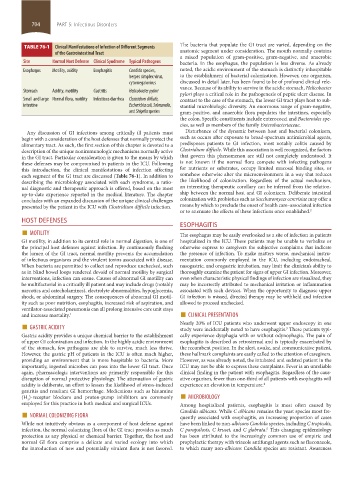
                   TABLE 76-1     Clinical Manifestations of Infection of Different Segments
                             of the Gastrointestinal Tract             anatomic segment under consideration. The mouth normally contains
                                                                       a mixed population of gram-positive, gram-negative, and anaerobic
                  Site      Normal Host Defense Clinical Syndrome Typical Pathogens  bacteria. In the esophagus, the population is less diverse. As already
                  Esophagus  Motility, acidity  Esophagitis  Candida species,   noted, the acidic environment of the stomach is distinctly inhospitable
                                                      herpes simplex virus,   to the establishment of bacterial colonization. However, one organism,
                                                        cytomegalovirus  discussed in detail later, has been found to be of profound clinical rele-
                                                                       vance. Because of its ability to survive in the acidic stomach, Helicobacter
                  Stomach   Acidity, motility  Gastritis  Helicobacter pylori
                                                                       pylori plays a critical role in the pathogenesis of peptic ulcer disease. In
                  Small and large  Normal flora, motility  Infectious diarrhea Clostridium difficile,   contrast to the case of the stomach, the lower GI tract plays host to sub-
                  intestine                           Escherichia coli, Salmonella,   stantial microbiologic diversity. An enormous range of gram-negative,
                                                      and Shigella species  gram-positive, and anaerobic flora populates the intestines, especially
                                                                       the colon. Specific constituents include enterococci and Bacteroides spe-
                                                                       cies, as well as members of the family Enterobacteriaceae.
                   Any discussion of GI infections among critically ill patients must   Disturbance of the dynamic between host and bacterial colonizers,
                 begin with a consideration of the host defenses that normally protect the   such as occurs after exposure to broad-spectrum antimicrobial agents,
                 alimentary tract. As such, the first section of this chapter is devoted to a   predisposes patients to GI infection, most notably colitis caused by
                 description of the unique nonimmunologic mechanisms normally active   Clostridium difficile. While this association is well recognized, the  factors
                 in the GI tract. Particular consideration is given to the means by which   that govern  this phenomenon are still not completely understood.  It
                 these defenses may be compromised in patients in the ICU. Following   is not known if the normal flora compete with infecting pathogens
                 this  introduction,  the  clinical  manifestations  of  infection  affecting   for nutrients or  substrates, occupy limited  mucosal binding sites, or
                 each segment of the GI tract are discussed (Table 76-1). In addition to   somehow otherwise alter the microenvironment in a way that reduces
                 describing the microbiology associated with each syndrome, a ratio-  the likelihood of colonization. Regardless of the actual mechanism,
                 nal diagnostic and therapeutic approach is offered, based on the most   an interesting therapeutic corollary can be inferred from the relation-
                 up-to-date experience reported in the medical literature. The chapter   ship between the normal host and GI colonizers. Deliberate intestinal
                 concludes with an expanded discussion of the unique clinical challenges   colonization with probiotics such as Saccharomyces cerevisiae may offer a
                 presented by the patient in the ICU with Clostridium difficile infection.  means by which to preclude the onset of health care–associated infection
                                                                       or to attenuate the effects of these infections once established. 2
                 HOST DEFENSES                                         ESOPHAGITIS
                     ■  MOTILITY                                       The esophagus may be easily overlooked as a site of infection in patients

                 GI motility, in addition to its central role in normal digestion, is one of   hospitalized in the ICU. These patients may be unable to verbalize or
                 the principal host defenses against infection. By continuously flushing   otherwise express to caregivers the subjective complaints that indicate
                 the lumen of the GI tract, normal motility prevents the accumulation   the presence of infection. To make matters worse, mechanical instru-
                 of infectious organisms and the virulent toxins associated with disease.   mentation commonly employed in the ICU, including endotracheal,
                 When bacteria are permitted to collect and reproduce unchecked, such   nasogastric, and orogastric intubation, may limit the clinician’s ability to
                 as in blind bowel loops rendered devoid of normal motility by surgical   thoroughly examine the patient for signs of upper GI infection. Moreover,
                 interventions, infection can ensue. Causes of abnormal GI motility can   even when characteristic physical findings of infection are visualized, they
                 be multifactorial in a critically ill patient and may include drugs (notably   may be incorrectly attributed to mechanical irritation or inflammation
                 narcotics and catecholamines), electrolyte abnormalities, hypoglycemia,   associated with such devices. When the opportunity to diagnose upper
                 shock, or abdominal surgery. The consequences of abnormal GI motil-  GI infection is missed, directed therapy may be withheld and infection
                 ity such as poor nutrition, esophagitis, increased risk of aspiration, and   allowed to proceed unchecked.
                 ventilator-associated pneumonia can all prolong intensive care unit stays
                 and increase mortality. 1                                 ■  CLINICAL PRESENTATION
                     ■  GASTRIC ACIDITY                                Nearly 20% of ICU patients who underwent upper endoscopy in one
                                                                                                           3
                                                                       study were incidentally noted to have esophagitis.  These patients typi-
                 Gastric acidity provides a unique chemical barrier to the establishment   cally experience dysphagia with or without odynophagia. The pain of
                 of upper GI colonization and infection. In the highly acidic environment   esophagitis is described as retrosternal and is typically exacerbated by
                 of the stomach, few pathogens are able to survive, much less thrive.   the recumbent position. In the alert, awake, and communicative patient,
                 However, the gastric pH of patients in the ICU is often much higher,   these hallmark complaints are easily called to the attention of caregivers.
                 providing an environment that is more hospitable to bacteria. More   However, as was already noted, the intubated and sedated patient in the
                 importantly, ingested microbes can pass into the lower GI tract. Once   ICU may not be able to express these complaints. Fever is an unreliable
                 again, pharmacologic interventions are primarily responsible for this   clinical finding in the patient with esophagitis. Regardless of the caus-
                 disruption of normal protective physiology. The attenuation of gastric   ative organism, fewer than one-third of all patients with esophagitis will
                 acidity is deliberate, an effort to lessen the likelihood of stress-induced   experience an elevation in temperature. 4
                 gastritis and resultant GI hemorrhage. Medications such as histamine     ■
                 (H )-receptor blockers and proton-pump inhibitors are commonly   MICROBIOLOGY
                   2
                 employed for this practice in both medical and surgical ICUs.  Among hospitalized patients, esophagitis is most often caused by
                     ■  NORMAL COLONIZING FLORA                        Candida albicans. While C albicans remains the yeast species most fre-
                                                                       quently associated with esophagitis, an increasing proportion of cases
                 While not intuitively obvious as a component of host defense against   have been linked to non-albicans Candida species, including C tropicalis,
                                                                                                     5
                 infection, the normal colonizing flora of the GI tract provides as much   C parapsilosis, C krusei, and C glabrata.  This changing epidemiology
                 protection as any physical or chemical barrier. Together, the host and   has been attributed to the increasingly common use of empiric and
                 normal GI  flora comprise a delicate and varied ecology into which   prophylactic therapy with triazole antifungal agents such as fluconazole,
                 the introduction of new and potentially virulent flora is not favored.   to which many non-albicans Candida species are resistant. Awareness


            section05_c74-81.indd   704                                                                                1/23/2015   12:37:28 PM

