


Page 966 - Hall et al (2015) Principles of Critical Care-McGraw-Hill
P. 966
CHAPTER 75: Urinary Tract Infections  697


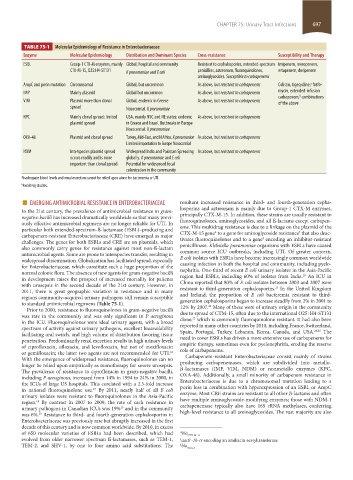
                      TABLE 75-1    Molecular Epidemiology of Resistance in Enterobacteriaceae
                    Enzyme          Molecular Epidemiology  Distribution and Dominant Species  Cross-resistance  Susceptibility and Therapy
                    ESBL            Group-1 CTX-M enzymes, mainly  Global, hospital and community  Resistant to cephalosporins, extended-spectrum  Imipenem, meropenem,
                                    CTX-M-15, O25:H4-ST131   K pneumoniae and E coli  penicillins, aztreonam, fluoroquinolones,     ertapenem, doripenem
                                                                                  aminoglycosides. Susceptible to carbapenems
                    AmpC and porin mutation Chromosomal  Global, but uncommon   As above, but resistant to carbapenems  Colistin, tigecycline,  fosfo-
                                                                                                                      a
                    IMP             Mainly plasmid     Global but uncommon      As above, but resistant to carbapenems  mycin, extended-infusion
                                                                                                           carbapenem,  combinations
                                                                                                                  b
                    VIM             Plasmid more than clonal   Global, endemic in Greece  As above, but resistant to carbapenems  of the above
                                    spread             Nosocomial. K pneumoniae
                    KPC             Mainly clonal spread; limited   USA, mainly NYC and NE states; endemic  As above, but resistant to carbapenems
                                    plasmid spread     in Greece and Israel. Outbreaks in Europe
                                                       Nosocomial. K pneumoniae
                    OXA-48          Plasmid and clonal spread  Turkey, Mid-East, and N Africa. K pneumoniae  As above, but resistant to carbapenems
                                                       Limited importation to Europe Nosocomial
                    NDM             Interspecies plasmid spread   Widespread India and Pakistan Spreading  As above, but resistant to carbapenems
                                    occurs readily and is more   globally. K pneumoniae and E coli
                                    important than clonal spread  Potential for widespread fecal
                                                       colonization in the community
                    a Inadequate blood levels and renal excretion cannot be relied upon alone for bacteremia or UTI.
                    b Awaiting studies.
                        ■  EMERGING ANTIMICROBIAL RESISTANCE IN ENTEROBACTERIACEAE  resultant increased resistance in third- and fourth-generation cepha-


                    In the 21st century, the prevalence of antimicrobial resistance in gram-  losporins and aztreonam is mainly due to Group-1 CTX-M enzymes,
                    negative bacilli has increased dramatically worldwide so that many previ-  principally CTX-M-15. In addition, these strains are usually resistant to
                    ously effective antimicrobial regimens are no longer reliable for UTI. In   fluoroquinolones, aminoglycosides, and all ß-lactams except carbapen-
                    particular both extended-spectrum-ß-lactamase (ESBL)–producing and   ems. This multidrug resistance is due to a linkage on the plasmid of the
                                                                                                                  †
                    carbapenem-resistant Enterobacteriaceae (CRE) have emerged as major   CTX-M-15 gene* to a gene for aminoglycoside resistance  that also deac-
                                                                                                      ‡
                    challenges. The genes for both ESBLs and CRE are on plasmids, which   tivates fluoroquinolones and to a gene  encoding an inhibitor-resistant
                    also commonly carry genes for resistance against most non-ß-lactam   penicillinase. Klebsiella pneumoniae organisms with ESBLs have caused
                    antimicrobial agents. Some are prone to interspecies transfer, resulting in   common source ICU outbreaks, including UTI. Of greater concern,
                    widespread dissemination. Globalization has facilitated spread, especially   E coli isolates with ESBLs have become increasingly common worldwide
                    for Enterobacteriaceae, which constitute such a huge proportion of the   causing infection in both the hospital and community, including pyelo-
                    normal colonic flora. The absence of new agents for gram-negative bacilli   nephritis. One-third of recent E coli urinary isolates in the Asia-Pacific
                                                                                                                   18
                    in development raises the prospect of increased mortality for patients   region had ESBLs, including 60% of isolates from India.  An ICU in
                                                                          China reported that 80% of E coli isolates between 2003 and 2007 were
                    with urosepsis in the second decade of the 21st century. However, in                  21
                    2011, there is great geographic variation in resistance and in many   resistant to third-generation cephalosporins.  In the United Kingdom
                                                                          and Ireland, the proportion of  E coli bacteremia resistant to third-
                    regions community-acquired urinary pathogens still remain susceptible
                    to standard antimicrobial regimens (Table 75-1).      generation cephalosporins began to increase steadily from 2% in 2001 to
                                                                          12% by 2007.  Many of these were of urinary origin in the community
                                                                                   22
                     Prior to 2000, resistance to fluoroquinolones in gram-negative bacilli
                    was rare in the community and was only significant in  P aeruginosa   due to spread of CTM-15, often due to the international O25 : H4-ST131
                                                                          clone,  which is commonly fluoroquinolone resistant. It had also been
                                                                              23
                    in the ICU. Fluoroquinolones were ideal urinary agents, with a broad
                    spectrum of activity against urinary pathogens, excellent bioavailability   reported in many other countries by 2010, including France, Switzerland,
                                                                          Spain, Portugal, Turkey, Lebanon,  Korea, Canada, and  USA.
                                                                                                                            The
                                                                                                                       24,25
                    facilitating oral switch, and high volume of distribution favoring tissue
                    penetration. Predominantly renal excretion results in high urinary levels   need to cover ESBLs has driven a more extensive use of carbapenems for
                                                                          empiric therapy, sometimes even for pyelonephritis, eroding the reserve
                    of ciprofloxacin, ofloxacin, and levofloxacin, but not of moxifloxacin
                    or gemifloxacin; the latter two agents are not recommended for UTI.    role of carbapenems.
                                                                      16
                    With the emergence of widespread resistance, fluoroquinolones can no   Carbapenem-resistant Enterobacteriaceae consist mainly of strains
                    longer be relied upon empirically as monotherapy for severe urosepsis.   producing carbapenemases, which are subdivided into metallo-
                    The prevalence of resistance to ciprofloxacin in gram-negative bacilli,   β-lactamases (IMP, VIM, NDM) or nonmetallo enzymes (KPC,
                    including P aeruginosa, increased from 14% in 1994 to 24% in 2000, in   OXA-48). Additionally, a small minority of carbapenem resistance in
                    the ICUs of large US hospitals. This corelated with a 2.5-fold increase   Enterobacteriaceae is due to a chromosomal mutation leading to a
                    in national fluoroquinolone use.  By 2011, nearly half of all  E coli   porin loss in combination with hyperexpression of an ESBL or AmpC
                                            17
                    urinary isolates were resistant to fluoroquinolones in the Asia-Pacific   enzyme. Most CRE strains are resistant to all other β-lactams and often
                    region.  By contrast in 2007 to 2009, the rate of such resistance in   have multiple aminoglycoside-modifying enzymes; those with NDM-1
                         18
                    urinary pathogens in Canadian ICUs was 19%  and in the community   carbapenemase typically also have 16S rRNA methylases, conferring
                                                     19
                    was 6%.  Resistance to third- and fourth-generation cephalosporins in   high-level resistance to all aminoglycosides. The vast majority are also
                         20
                    Enterobacteriaceae was previously rare but abruptly increased in the first
                    decade of this century and is now common worldwide. By 2010, in excess
                    of 650 molecular varieties of ESBLs had been described, which had   *bla CTX-M-15
                    evolved from older narrower spectrum ß-lactamases, such as TEM-1,    † aac6 -1b-cr encoding an amikacin acetyltransferase
                                                                             1
                    TEM-2, and SHV-1, by one to four amino acid substitutions. The   ‡ bla
                                                                            OXA-1
            section05_c74-81.indd   697                                                                                1/23/2015   12:37:26 PM

