


Page 963 - Hall et al (2015) Principles of Critical Care-McGraw-Hill
P. 963
694     PART 5: Infectious Disorders


                 agent. 1,7,18,37  In settings where community associated MRSA is suspected,   fistula. Predisposing factors include diabetes mellitus, obesity, advanced
                 vancomycin (2 g/day in two divided doses) or another agent with reli-  age, renal disease, and local trauma; diabetes mellitus is reported most
                 able activity against MRSA in skin and soft tissue infections, including   commonly. With myonecrosis due to group A streptococci, no predis-
                 linezolid, daptomycin, or ceftaroline is indicated.  In penicillin-allergic   posing factors may be present. In drug addicts, infections of the extremi-
                                                    7,18
                 patients, metronidazole or chloramphenicol is useful as an alternative   ties  are more common, whereas  perineal and  buttock infections  are
                 anaerobic agent. The addition of intravenous immunoglobulins, 0.4 g/kg     more common in other populations.
                 per day for 4 to 5 days or 2 g/kg as a single dose with a repeat dose in    When multiple microorganisms are responsible for myonecrosis, the
                 48 hours if the patient remains unstable, may be a useful adjunct for   facultative bacteria assist the growth of anaerobes by using available
                 streptococcal toxic shock syndrome. 7,37,39-41        oxygen and destroying tissue (reducing the redox potential), which
                   The mainstay of management is surgical exploration, debridement,   promotes a favorable milieu for the proliferation of anaerobic organ-
                 and drainage, which should be done as soon as possible. 1,7,37  Debridement   isms. The process often involves muscle and fascia extensively, and it
                 and excision of all necrotic subcutaneous adipose tissue and fascia is   may secondarily involve areas of subcutaneous tissue and skin. It should
                 required. The wound should be packed open. Daily exploration under   be noted that necrotizing fasciitis will ultimately involve muscle, if left
                 general anesthesia is indicated for truncal or perirectal infections and for   to progress.
                 all patients who remain in a toxic condition. Frequent dressing changes
                 are performed after suitable analgesia and are continued until healthy   Etiology:  Clostridium  perfringens is the most common cause of clos-
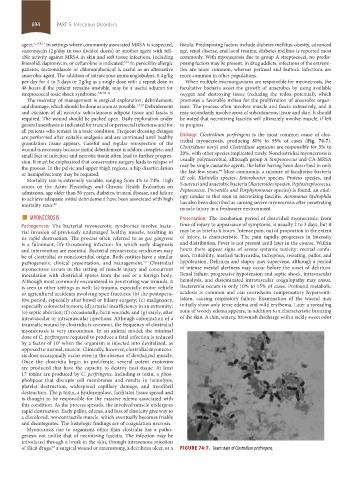
                 granulation tissue appears. Careful and regular reinspection of the   tridial myonecrosis, producing 80% to 95% of cases (Fig. 74-7).
                 wound is necessary because initial debridement is seldom complete, and   Clostridium novyi and Clostridium septicum are responsible for 5% to
                 small foci of infection and necrotic tissue often lead to further progres-  20%, with other species implicated rarely. Nonclostridial myonecrosis is
                 sion. It must be emphasized that conservative surgery leads to relapse of   usually polymicrobial, although group A Streptococcus and CA-MRSA
                 the process. In the pelvic and upper thigh regions, a hip disarticulation   may be single causative agents, the latter having been described in only
                                                                                    44
                 or hemipelvectomy may be required.                    the last few years.  Most commonly, a mixture of facultative bacteria
                   Mortality rate is extremely variable, ranging from 4% to 74%. High   (E coli,  Klebsiella species,  Enterobacter species,  Proteus species, and
                 scores on the Acute Physiology and Chronic Health Evaluation on   S aureus) and anaerobic bacteria (Bacteroides species, Peptostreptococcus,
                 admission, age older than 50 years, diabetes, truncal disease, and failure   Peptococcus, Prevotella and Porphyromonas species) is found, an etiol-
                 to achieve adequate initial debridement have been associated with high   ogy similar to that seen in necrotizing fasciitis. Aeromonas hydrophila
                 mortality rates. 42                                   has also been described as causing severe myonecrosis after penetrating
                                                                       muscle injury in a freshwater environment.
                     ■  MYONECROSIS                                    Presentation:  The incubation period of clostridial myonecrosis, from

                 Pathogenesis:  The bacterial myonecrotic syndromes involve bacte-  time of injury to appearance of symptoms, is usually 2 to 3 days, but it
                 rial invasion of previously undamaged healthy muscle, resulting in   may be as brief as 6 hours. Intense pain, out of proportion to the extent
                 its rapid destruction. The process often referred to as  gas gangrene   of injury, is characteristic. The pain rapidly progresses in intensity
                 is a fulminant, life-threatening infection for which early diagnosis   and distribution. Fever is not present until later in the course. Within
                 and intervention are essential. Bacterial myonecrotic syndromes may   hours there appear signs of severe systemic toxicity: mental confu-
                 be of clostridial or nonclostridial origin. Both entities have a similar   sion, irritability, marked tachycardia, tachypnea, sweating, pallor, and
                 pathogenesis, clinical presentation, and management.  Clostridial   hypotension. Delirium and stupor may supervene, although a period
                                                           5,7
                 myonecrosis occurs in the setting of muscle injury and concurrent   of intense mental alertness may occur before the onset of delirium.
                 inoculation with clostridial spores from the soil or a foreign body.   Renal failure, progressive hypotension and septic shock, intravascular
                 Although most commonly encountered in penetrating war wounds, it   hemolysis,  and  disseminated  intravascular  coagulopathy  may  ensue.
                 is seen in other settings as well: (a) trauma, especially motor vehicle   Bacteremia occurs in only 10% to 15% of cases. Profound metabolic
                 or agricultural accidents involving open fractures; (b) the postopera-  acidosis is common and can overwhelm compensatory hyperventi-
                 tive period, especially after bowel or biliary surgery; (c) malignancy,   lation, causing respiratory failure. Examination of the wound may
                 especially colorectal tumors; (d) arterial insufficiency in an extremity;   initially show only tense edema and mild erythema. Later a spreading
                 (e) septic abortion; (f) occasionally, burn wounds; and (g) rarely, after   zone of woody edema appears, in addition to a characteristic bronzing
                 intravascular or intramuscular injections. Although colonization of a   of the skin. A thin, watery, brownish discharge with a sickly sweet odor
                 traumatic wound by clostridia is common, the frequency of clostridial
                 myonecrosis is very uncommon. In an animal model, the minimal
                 dose of C. perfringens required to produce a fatal infection is reduced
                 by a factor of 10  when the organism is injected into devitalized, as
                              6
                 opposed to normal, muscle. Clinically, however, clostridial myonecro-
                 sis does occasionally occur even in the absence of devitalized muscle.
                 Once the clostridia begin to proliferate, several potent exotoxins
                 are produced that have the capacity to destroy host tissue. At least
                 17 toxins are produced by C. perfringens, including α toxin, a phos-
                 pholipase that disrupts cell membranes and results in hemolysis,
                 platelet destruction, widespread capillary damage, and myofibril
                 destruction. The μ toxin, a hyaluronidase, facilitates tissue spread and
                 is thought to be responsible for the massive edema associated with
                 this condition. As the process spreads, the involved muscle undergoes
                 rapid destruction. Early pallor, edema, and loss of elasticity give way to
                 a discolored, noncontractile muscle, which eventually becomes friable
                 and disintegrates. The histologic findings are of coagulation necrosis.
                   Myonecrosis due to organisms other than clostridia has a patho-
                 genesis not unlike that of necrotizing fasciitis. The infection may be
                 introduced through a break in the skin, through intravenous injection
                 of illicit drugs,  a surgical wound or enterostomy, a decubitus ulcer, or a   FIGURE 74-7.  Gram stain of Clostridium perfringens.
                            43


            section05_c74-81.indd   694                                                                                1/23/2015   12:37:25 PM

