


Page 991 - Hall et al (2015) Principles of Critical Care-McGraw-Hill
P. 991
722     PART 5: Infectious Disorders


                 THE BIOLOGY OF MALARIAL PARASITES                       When infected mosquitoes bite humans (Fig. 78-2), needle-shaped
                                                                       sporozoite stages of infection (approximately half a dozen) are injected
                 Since antiquity malaria has been a potent selective force on humanity’s   and migrate within an hour to the liver to begin a clinically silent stage of
                 history and its genes.  Some Egyptian pharaohs carried malarial  parasites    intense multiplication within hepatocytes. One sporozoite can produce
                                                                    2
                                1
                 and  there  are many  descriptions  of  fevers  in ancient  cultures that are   tens of thousands of progeny within 5 to 16 days, depending on species;
                 consistent with the diagnosis of malaria. Alphonse Laveran in Algiers in   the median time for  P falciparum is 6 days. These progeny are then
                 1880 discovered that protozoan parasites cause malaria.  Since then, four   released into the bloodstream and multiply by asexual division in red
                                                         3
                 species of Plasmodium: P falciparum, P vivax, P malariae, and P ovale are   cells until after several cycles of logarithmic growth sufficient parasites
                 established as causes of natural human malaria infections, with a fifth   are generated to result in symptoms of disease. The numbers of parasites
                 species, P knowlesi, usually infecting monkeys, emerging as an important   needed to produce symptoms in an individual vary with species of para-
                 human pathogen in some geographic areas  (Fig. 78-1). All species of   site, as well as being influenced by host factors such as prior exposure to
                                                 4
                 malarias are naturally transmitted to humans by female Anopheles mos-  malaria, which can produce variable immunity to disease. P vivax and
                 quitoes when infected insects feed on blood. Annually, they account for   P ovale can also generate curious dormant or hypnozoite stages of arrested
                 an estimated 400 million episodes of malaria and 800,000 deaths.  Deaths   development in liver cells. These hypnozoites can activate months after
                                                               5
                 have been falling in recent years due to concerted efforts to control trans-  cure of the blood stages of infection by standard antimalarial treat-
                 mission of malaria, for example, by the use of insecticide treated bed nets,   ments so that an additional course of an 8-aminoquinoline class of drug
                 and the use of effective artemisinin combination therapies to treat clinical   ( primaquine) is needed to completely cure these species of infection.
                 episodes. Most cases of severe malaria are attributed to infections with     The time parasites take to replicate for one cycle in the blood depends
                 P falciparum although P vivax is increasingly recognized as causing severe   on species: P knowlesi has a 24-hour cycle, and P malariae has a 72-hour
                 morbidity in a minority of cases, as well as fatalities in some patients.    cycle with the other species needing 48 hours to feed, grow, multiply,
                                                                    6,7
                 P knowlesi can also cause severe disease and death.  Mixed species infec-  and reinvade red cells. P falciparum can produce up to 36  merozoites
                                                     8
                 tions are common in some areas.                       or daughter cells, with other species producing sometimes as few
                                                                       as 4. Together with innate and acquired host defense mechanisms, the
                                                                         replicative cycle length and multiplicative capacity (number of progeny
                                                                       produced by one parasite each cycle) are important determinants of
                                                                       the total numbers of parasites in a human, and these numbers in turn
                                                                       are  broadly  related  to  risk  of  disease  and  death  (discussed  in  greater
                                                                       detail below). 9,10

                                                                       EPIDEMIOLOGY
                                                                       There are almost 100 tropical countries that are endemic for malaria
                                                                       with  67  of  these  implementing  malaria  control  efforts  of  varying
                                                                       extent and 32 aiming to eliminate malaria. These concerted efforts to
                                                                       “shrink the malaria map” are having measurable and significant ben-
                                                                       efits in many areas, particularly those with moderate or low malaria
                                                                         endemicity.  The degree of endemicity of infection refers to the risk
                                                                                11
                                                                       to an individual of being exposed to bites of infected mosquitoes. This
                                                                       can range from more than one infected bite a day in some sub-Saharan
                                                                       countries, to less than one a year in many Asian countries. The age and
                                                                       duration of exposure to infected bites, together with other variables
                                                                       such as the presence of host resistance genes to malaria and nutritional
                                                                       status, act to influence the clinical features of disease (below). Even in
                                                                       tropical areas,  Anopheline mosquitoes cannot transmit malaria when
                                                                       the environment is too cold (<16°C) or too hot (>33°C) or too dry,
                                                                       and altitudes >1500 m are also inhospitable for parasite propagation.
                                                                       This still leaves an estimated 1.4 billion individuals living with a stable
                                                                       risk of P  falciparum malaria with about half in sub-Saharan Africa, half
                                                                       in Central and South East Asia, and 0.04 billion in the Americas. In
                                                                       Central Asia, many countries have transmission of both P falciparum
                                                                       and P vivax, whereas in Africa P vivax is found mainly in the Horn.
                                                                       P knowlesi is limited in its distribution to southeast Asia, where vectors
                                                                       (eg, of the A leucosphyrus group) can bite the natural hosts (long- and
                                                                       pig-tailed macaques) and also encounter humans. This primarily zoo-
                                                                       notic means of transmission usually takes place when humans enter
                                                                         forested areas. P knowlesi has been mistaken for P malariae in these areas
                                                                       although the latter  infection  is more common  in African countries.
                                                                                                                          4
                                                                       P ovale is found mainly in sub-Saharan Africa.
                                                                         The force of selection imposed by P falciparum infections was sug-
                                                                       gested by JBS Haldane to be the reason why high heterozygote fre-
                                                                       quencies of blood disorders such as thalassemias were maintained in
                                                                       populations, because these hemoglobinopathies might confer a degree
                                                                       of protection against sequelae of infection. This hypothesis has stood
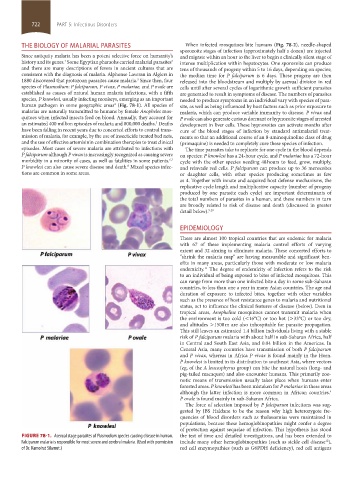
                 FIGURE 78-1.  Asexual stage parasites of Plasmodium species causing disease in human.   the test of time and detailed investigations, and has been extended to
                                                                                                                         12
                 Falciparum malaria is responsible for most severe and cerebral malaria. (Used with permission   include many other hemoglobinopathies (such as sickle cell disease ),
                 of Dr. Kamolrat Silamut.)                             red cell enzymopathies (such as G6PDH deficiency), red cell antigens


            section05_c74-81.indd   722                                                                                1/23/2015   12:37:35 PM

