


Page 995 - Hall et al (2015) Principles of Critical Care-McGraw-Hill
P. 995
726     PART 5: Infectious Disorders

                     ■  CIRCULATORY CHANGES                              CSF examination in the absence of contraindications is advised

                 Shock is not a common complication of severe malaria in either   in adults with cerebral symptoms to exclude coincident infections
                                                                       (bacterial or viral, for example). In children, because of possible risks
                 children  or  adults.  In  children,  there  has  been  controversy  about  the
                 degree of intravascular volume depletion and the need for aggressive   associated  with  raised  intracranial  pressure,  some  suggest  delaying
                                                                       CSF examination until antimalarial treatment has begun. A case can be
                 fluid   administration. 44,45  A recent randomized study in African chil-
                 dren found that both normal saline and albumin fluid bolus strategies   made for children and adults for starting empirical antibiotic therapies,
                                                                       as about a quarter of adults in intensive care in France had coinfections
                 increased mortality compared to a no-bolus strategy.  The study was
                                                        46
                 conducted in the absence of intensive care unit facilities. In adults, the   (both gram-positive and gram-negative and community acquired or
                                                                       nosocomial) diagnosed during their admission, and these were signifi-
                 risk of pulmonary edema and the ability to monitor hemodynamic                  50
                 status of patients comparatively easily guide implementation of the sug-  cantly more common in fatal cases.  The CSF shows little if any eleva-
                                                                       tions in cell count (usually below 50 cells/μL) and protein content.
                 gestion that patients should not be “overhydrated.” In children, although
                 there is less risk of pulmonary edema, there is a potential increased   DIFFERENTIAL DIAGNOSIS
                 risk of raised intracranial pressure and intracerebral displacement syn-
                 dromes, suggesting that decisions about volume replacement should be   Malaria should be distinguished from other acute infections (bacterial
                 guided by real-time assessments of hemodynamic status (see Chap. 34   sepsis or meningitis), viral encephalitides (particularly dengue fever with
                 regarding hemodynamic assessment).                    thrombocytopenia), enteric fevers and leptospirosis, severe influenza,
                                                                       viral hepatitis or hepatic failure due to other causes (Reye syndrome in
                 DIAGNOSIS                                             children), intoxications, and other noninfective causes of coma.
                 The diagnosis of malaria should be considered in any traveler return-
                 ing from malaria-endemic areas even if they have adopted appropriate   TREATMENT OF SEVERE FALCIPARUM MALARIA
                 malaria-prevention measures. In case patients have been pretreated with   Severe falciparum malaria is a medical emergency with a high case
                 antimalarials, peripheral parasitemia may be very difficult to detect,   fatality rate. In hospitalized African children with strictly defined severe
                 and the decision to begin antimalarial treatment becomes a clinical   malaria, mortality is around 11%, but this increases to 20% if the child
                 one,  although the  presence  of  malaria  pigment  in  leukocytes  and  a   presents with cerebral malaria (coma) where supportive facilities may be
                 positive PfHRP2-based rapid test can confirm the recent presence of    limited. Death occurs early after admission, with 65% of fatalities within
                 P falciparum. Malaria can occasionally arise in the vicinity of airports in   the first 24 hours and 83% within the first 48 hours.  In Asian adults
                                                                                                              51
                 nonendemic areas where infected mosquitoes are delivered by airplanes.  overall inhospital mortality in low resource settings is higher, around
                   Headaches, myalgias, and fever are the commonest features of malaria.   24% in severe malaria and 34% in cerebral malaria; 50% of patients die
                 These symptoms can emerge many months after travel, and sometimes   within the first 48 hours after admission.  In high resource settings
                                                                                                      52
                 even longer if antimalarial prophylaxis was used. Most travelers (~80%)   with state-of-the-art critical care facilities, mortality of imported severe
                 develop symptoms of malaria within a month of leaving endemic areas,   malaria is around 11%.  In this setting, higher parasitemia, increased
                                                                                        50
                 and cannot develop symptoms earlier than 1 week after being bitten by   age, and depth of coma independently predicted fatal outcome.
                 an infected mosquito. Other nonspecific symptoms such as diarrhea,   Management of severe malaria consists of promptly starting adequate
                 vomiting, cough, fatigue, and weakness are also common. Periodicity of   parenteral antimalarial treatment, treatment of concomitant diseases,
                 fever so well described in classical texts on malaria is not a diagnostically   and supportive treatments. No adjuvant therapies have been proven to
                 useful sign for falciparum malaria as often fevers are irregular.  be beneficial.
                   The onset of coma indicating cerebral involvement can be heralded   Blood glucose (and lactate) should be monitored frequently and regu-
                 by seizures or confusion. Often there is biochemical evidence of other   larly together with peripheral parasitemia and its response to treatment.
                 organ involvement, such as renal or hepatic impairment. Metabolic   Hematological changes including worsening anemia should be detected
                 derangements and thrombocytopenia are also frequently observed.  and corrected. Changes in the white count are variable, and phagocytic
                   Microscopic diagnosis is still the gold standard for confirming   cells can be seen carrying malarial pigment in blood films. Electrolyte
                 malaria.  Good  quality  thick  and  thin  films  stained  conventionally   examinations often show mild hyponatremia and hypophosphatemia.
                 should be examined by experienced microscopists.  Thick films are   Other  abnormalities  in  electrolytes  or  biochemistry  are indicative  of
                                                       43
                 more sensitive at detecting parasites but thin films are better at reveal-  specific organ involvement.
                 ing morphological details useful to speciate most parasites. P knowlesi
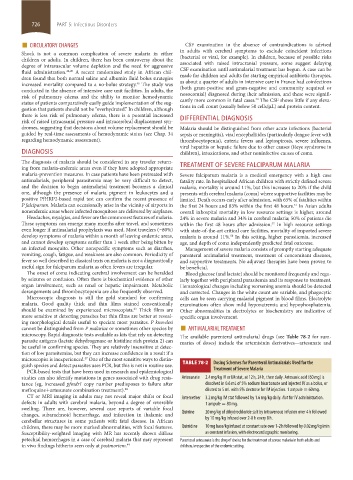
                 cannot be distinguished from P malariae or sometimes other species by     ■  ANTIMALARIAL TREATMENT
                 microscopy. Rapid diagnostic tests available as kits that rely on detecting   The available parenteral antimalarial drugs (see  Table  78-2 for sum-
                 parasite antigens (lactate dehydrogenase or histidine rich protein 2) can   maries of doses) include the artemisinin derivatives—artesunate and
                 be useful in confirming species. They are relatively insensitive at detec-
                 tion of low parasitemias, but they can increase confidence in a result if a
                 microscopist is inexperienced.  One of the most sensitive ways to distin-
                                       47
                 guish species and detect parasites uses PCR, but this is not in routine use.    TABLE 78-2     Dosing Schemes for Parenteral Antimalarials Used for the
                   PCR-based tests that have been used in research and epidemiological   Treatment of Severe Malaria
                 studies can also identify mutations in genes associated with drug resis-  Artesunate  2.4 mg/kg IV or IM stat, at 12 h, 24 h, then daily. Artesunic acid (60 mg) is
                 tance (eg, increased  pfmdr1 copy number predisposes to failure after     dissolved in 0.6 mL of 5% sodium bicarbonate and injected IV as a bolus, or
                 mefloquine+artesunate combination treatment). 48               diluted to 5 mL with 5% dextrose for IM injection. 1 ampule = 60 mg.
                   CT or MRI imaging in adults may not reveal major shifts or focal   Artemether 3.2 mg/kg IM stat followed by 1.6 mg/kg daily. Not for IV administration.
                 defects in adults with cerebral malaria, beyond a degree of reversible   1 ampule = 80 mg.
                 swelling. There are, however, several case reports of variable focal
                 changes, subarachnoid hemorrhage, and infarction in thalamic and   Quinine  20 mg/kg of dihydrochloride salt by intravenous infusion over 4 h followed
                 cerebellar structures in some patients with fatal disease. In African   by 10 mg/kg infused over 2-8 h every 8 h.
                 children, there may be more marked abnormalities, with focal features.   Quinidine  10 mg base/kg infused at constant rate over 1-2 h followed by 0.02 mg/kg/min
                 Susceptibility-weighted imaging  with MR  has recently shown diffuse   as constant infusion, with electrocardiographic monitoring.
                 petechial hemorrhages in a case of cerebral malaria that may represent   Parenteral artesunate is the drug of choice for the treatment of severe malaria in both adults and
                 in vivo findings hitherto seen only at postmortem. 49  children,  irrespective of the endemic setting.


            section05_c74-81.indd   726                                                                                1/23/2015   12:37:39 PM

