


Page 993 - Hall et al (2015) Principles of Critical Care-McGraw-Hill
P. 993
724     PART 5: Infectious Disorders


                   TABLE 78-1    Manifestations and Complication of Severe Falciparum Malaria
                  Manifestation or
                  Complication  Pathophysiology   Treatment
                  Coma (Glasgow   Sequestration of parasitized   Hypoglycemia and other causes
                  Coma Score <11;   red blood cells in the cerebral   of meningo/encephalitis should
                  Blantyre Coma     microcirculation and other   be excluded. Good general
                  Score <3) and    factors        intensive nursing care, including
                    convulsions                   close observation of breathing,
                                                  eye care, nasogastric tube, Foley
                                                  catheter. If feasible: intubation to
                                                  protect  airway. Frequent moni-
                                                  toring of blood glucose. Treat
                                                  convulsions (eg, lorazepam).
                                                  Prophylactic anticonvulsive treat-
                                                  ment is not recommended
                  Anemia (Hct   Loss of parasitized red blood cells,   General recommendation:
                  <20%, in presence  increased splenic clearance of unin-  transfusion if in distress, or Hct
                  of  parasitemia   fected red blood cells (decreased   <20% (adults), or Hb <5 g/dL
                  >100,000/μL)  red cell deformability, immuno-  in children
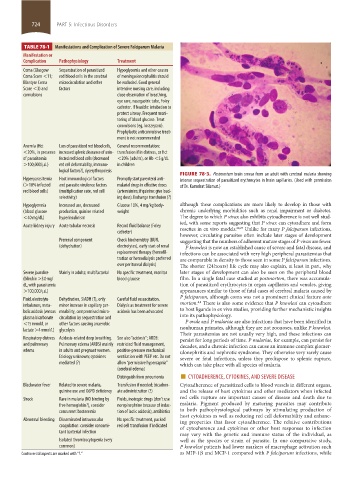
                              logical factors?), dyserythropoiesis     FIGURE 78-3.  Postmortem brain smear from an adult with cerebral malaria showing
                  Hyperparasitemia   Host immunological factors   Promptly start parenteral anti-  intense sequestration of parasitized erythrocytes in brain capillaries. (Used with permission
                  (>10% infected   and parasite virulence factors   malarial drugs in effective doses   of Dr. Kamolrat Silamut.)
                  red blood cells)  ( multiplication rate, red cell   (artemisinins; if quinine: give load-
                                selectivity)      ing dose). Exchange transfusion (?)
                  Hypoglycemia    Increased use, decreased    Glucose 10%, 4 mg/kg body-  although these complications are more likely to develop in those with
                  (blood glucose   production, quinine related   weight  chronic underlying morbidities such as renal impairment or diabetes.
                  <40 mg/dL)  hyperinsulinism                          The degree to which P vivax also exhibits cytoadherence is not well stud-
                                                                       ied, with some reports suggesting that P vivax can cytoadhere and form
                  Acute kidney injury Acute tubular necrosis  Record fluid balance (Foley   rosettes in ex vivo models. 22,23  Unlike for many P falciparum infections,
                                                  catheter)            however, circulating parasites often include later stages of development
                              Prerenal component    Check biochemistry (BUN,   suggesting that the numbers of adherent mature stages of P vivax are fewer.
                              (dehydration)       electrolytes), early start of renal   P knowlesi is now an established cause of severe and fatal disease, and
                                                  replacement therapy (hemofil-  infections can be associated with very high peripheral parasitemias that
                                                  tration or hemodialysis preferred   are comparable in density to those seen in some P falciparum infections.
                                                  over peritoneal dialysis)  The shorter (24 hours) life cycle may also explain, at least in part, why
                  Severe jaundice   Mainly in adults; multifactorial  No specific treatment, monitor   later stages of development can also be seen on the peripheral blood
                  ( bilirubin >3.0 mg/            blood glucose        film. In a single fatal case studied at postmortem, there was accumula-
                  dL, with parasitemia                                 tion of parasitized erythrocytes in organ capillaries and venules, giving
                  >100,000/μL)                                         appearances similar to those of fatal cases of cerebral malaria caused by
                  Fluid, electrolyte   Dehydration, SIADH (?), only   Careful fluid resuscitation.   P falciparum, although coma was not a prominent clinical feature ante
                                                                             4,8
                  imbalances, meta-  minor increase in capillary per-  Dialysis as treatment for severe   mortem.  There is also some evidence that P knowlesi can cytoadhere
                  bolic acidosis (venous  meability, compromised micro-  acidosis has been advocated  to host ligands in ex vivo studies, providing further mechanistic insights
                  plasma bicarbonate  circulation by sequestration and   into its pathophysiology.
                  <15 mmol/L or   other factors causing anaerobic        P ovale and P malariae are also infections that have been identified in
                    lactate >4 mmol/L) glycolysis                      nonhuman primates, although they are not zoonoses, unlike P knowlesi.
                                                                       Their parasitemias are not usually very high, and these infections can
                  Respiratory distress  Acidosis-related deep breathing.  See also “acidosis”; ARDS:   persist for long periods of time. P malariae, for example, can persist for
                  and pulmonary   Pulmonary edema (ARDS) mainly  restricted fluid management,   decades, and a chronic infection can cause an immune complex glomer-
                  edema       in adults and pregnant women.   positive-pressure mechanical   ulonephritis and nephrotic syndrome. They otherwise very rarely cause
                              Etiology unknown; cytokines   ventilation with PEEP etc. Do not   severe or fatal infections, unless they predispose to splenic rupture,
                                mediated (?)      allow “permissive hypercapnia”   which can take place with all species of malaria.
                                                  (cerebral edema)
                                                  Distinguish from pneumonia    ■  CYTOADHERENCE, CYTOKINES, AND SEVERE DISEASE
                  Blackwater fever  Related to severe malaria,    Transfusion if needed; bicarbon-  Cytoadherence of parasitized cells to blood vessels in different organs,
                              quinine use and G6PD deficiency  ate administration (?)  and the release of host cytokines and other mediators when infected
                  Shock       Rare in malaria (NO binding by   Fluids, inotropic drugs (don’t use   red cells rupture are important causes of disease and death due to
                              free hemoglobin?), consider   norepinephrine because of induc-  malaria.  Pigment produced by  maturing parasites may contribute
                              concurrent bacteremia  tion of lactic acidosis), antibiotics  to both pathophysiological pathways by stimulating production of
                                                                       host cytokines as well as reducing red cell deformability and enhanc-
                  Abnormal bleeding Disseminated intravascular   No specific treatment, packed   ing properties that favor cytoadherence. The relative contributions
                                coagulation: consider concomi-  red cell transfusion if indicated  of cytoaherence and cytokines or other host responses to infection
                              tant bacterial infection
                                                                       may vary with the genetic and immune status of the individual, as
                              Isolated thrombocytopenia (very          well as the species or strain of parasite. In one comparative study,
                              common)                                  P knowlesi patients had lower markers of macrophage activation such
                 Controversial aspects are marked with “?.”            as MIP-1β and MCP-1 compared with P falciparum infections, while


            section05_c74-81.indd   724                                                                                1/23/2015   12:37:37 PM

