


Page 992 - Hall et al (2015) Principles of Critical Care-McGraw-Hill
P. 992
CHAPTER 78: Severe Malaria  723


                                                                                         Salivary glands


                                                              Sporozoites
                                                  ~10                   Mosquito
                                                                                             Sporozoites
                                                              Liver
                                                               10 5
                                                                RBC
                                                                  Merozoites

                                           10 8–11 (uncomplicated)      Mosquito                  Oocyst
                                           to 10 12–13 (severe)           gut

                                                    Trophozoite                                Ookinete
                                                                                             Zygote
                                                       Gametocytes
                                                                                             Gametes


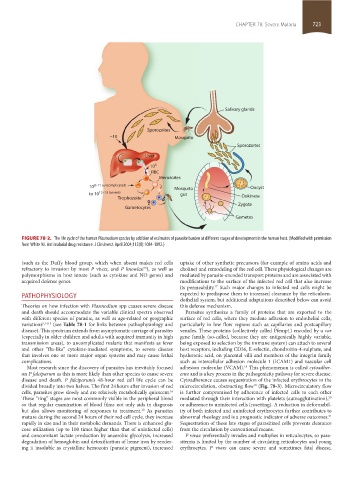
                    FIGURE 78-2.  The life cycle of the human Plasmodium species by addition of estimates of parasite burden at different stages of development in the human host. (Modified with permission
                    from White NJ. Antimalarial drug resistance. J Clin Invest. April 2004;113(8):1084-1092.)


                    (such as the Duffy blood group, which when absent makes red cells   uptake of other synthetic precursors (for example of amino acids and
                    refractory to invasion by most  P vivax, and  P knowlesi ), as well as   choline) and remodeling of the red cell. These physiological changes are
                                                             13
                    polymorphisms in host innate (such as cytokine and NO genes) and   mediated by parasite-encoded transport proteins and are associated with
                    acquired defense genes.                               modifications to the surface of the infected red cell that also increase
                                                                          its permeability.  Such major changes to infected red cells might be
                                                                                     17
                    PATHOPHYSIOLOGY                                       expected to predispose them to increased clearance by the reticuloen-
                                                                          dothelial system, but additional adaptations described below can avoid
                    Theories on how infection with Plasmodium spp causes severe disease   this defense mechanism.
                    and death should accommodate the variable clinical spectra observed   Parasites synthesize a family of proteins that are exported to the
                    with different species of parasite, as well as age-related or geographic   surface of red cells, where they mediate adhesion to endothelial cells,
                    variations 9,14,15  (see Table 78-1 for links between pathophysiology and   particularly in low flow regions such as capillaries and postcapillary
                    disease). This spectrum extends from asymptomatic carriage of parasites   venules. These proteins (collectively called Pfemp1) encoded by a var
                    (especially in older children and adults with acquired immunity in high   gene family (so-called, because they are antigenically highly variable,
                    transmission areas), to uncomplicated malaria that manifests as fever   being exposed to selection by the immune system) can attach to several
                    and other “flu-like”  cytokine-mediated symptoms, to severe  disease   host receptors, including CD36, E-selectin, chondroitin-4-sulphate, and
                    that involves one or more major organ systems and may cause lethal   hyaluronic acid, on placental villi and members of the integrin family
                    complications.                                        such as intercellular adhesion molecule 1 (ICAM1) and vascular cell
                     Most research since the discovery of parasites has inevitably focused   adhesion molecular (VCAM).  This phenomenon is called cytoadher-
                                                                                               18
                    on P falciparum as this is more likely than other species to cause severe   ence and is a key process in the pathogenicity pathway for severe disease.
                    disease and  death.  P falciparum’s  48-hour red cell life cycle can  be   Cytoadherence causes sequestration of the infected erythrocytes in the
                    divided broadly into two halves. The first 24 hours after invasion of red   microcirculation, obstructing flow  (Fig. 78-3). Microcirculatory flow
                                                                                                   19
                    cells, parasites grow slowly and are relatively metabolically quiescent.    is further compromised by adherence of infected cells to each other
                                                                      16
                    These “ring” stages are most commonly visible in the peripheral blood   mediated through their interaction with platelets (autoagglutination),
                                                                                                                            20
                    so that regular examination of blood films not only aids in diagnosis   or adherence to uninfected cells (rosetting). A reduction in deformabil-
                    but also allows monitoring of responses to treatment.  As parasites   ity of both infected and uninfected erythrocytes further contributes to
                                                            10
                    mature during the second 24 hours of their red cell cycle, they increase   abnormal rheology and is a prognostic indicator of adverse outcomes.
                                                                                                                            21
                    rapidly in size and in their metabolic demands. There is enhanced glu-  Sequestration of these late stages of parasitized cells prevents clearance
                    cose utilization (up to 100 times higher than that of uninfected cells)   from the circulation by conventional means.
                    and concomitant lactate production by anaerobic glycolysis, increased   P vivax preferentially invades and multiplies in reticulocytes, so para-
                    degradation of hemoglobin and detoxification of heme iron by render-  sitemia is limited by the number of circulating reticulocytes and young
                    ing  it  insoluble  as  crystalline  hemozoin  (parasite  pigment),  increased   erythrocytes.  P vivax can cause severe and sometimes fatal disease,


            section05_c74-81.indd   723                                                                                1/23/2015   12:37:36 PM

