


Page 254 - Psychology of Wounds and Wound Care in Clinical Practice ( PDFDrive )
P. 254
Different Treatments and Psychological Outcomes  229

           objectives, regular reviews and onward referral to specialist
           when patients are not progressing as expected. She advocates
           wound care should address every need of the patient in order
           to maximise their quality of life, taking an holistic approach
           which may involve addressing concurrent issues such as
           under-nutrition, illness and infection and their social environ-
           ment. Listening to, and involving patients in a collaborative
           care plan with appropriate goals is also important (Dowsett
             2008 ) and may help reduce the incidence of psychological
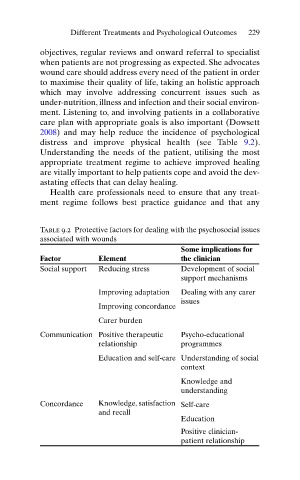
           distress and improve physical health (see  Table   9.2 ).
           Understanding the needs of the patient, utilising the most
           appropriate treatment regime to achieve improved healing
           are vitally important to help patients cope and avoid the dev-
           astating effects that can delay healing.
                Health care professionals need to ensure that any treat-
           ment regime follows best practice guidance and that any


              Table 9.2     Protective factors for dealing with the psychosocial issues
           associated with wounds
                                              Some implications for
            Factor        Element           the clinician
             Social support     Reducing stress     Development of social
                                            support mechanisms
                           Improving adaptation     Dealing with any carer
                                            issues
                          Improving concordance
                          Carer burden
            Communication   Positive therapeutic    Psycho-educational
                         relationship       programmes
                           Education and self-care   Understanding of social
                                            context
                                             Knowledge and
                                            understanding
            Concordance    Knowledge, satisfaction   Self-care
                         and recall
                                             Education
                                             Positive clinician-
                                            patient relationship

