


Page 61 - Psychology of Wounds and Wound Care in Clinical Practice ( PDFDrive )
P. 61
34   Chapter 2.  Pain


                                    Descending control


           Large diameter nerve fibres
           carry non-painful information


                             Spinal
                              cord         T-Cells


           Small diameter fibres carry
           painful impulses
                                      Gate, open or closed:
                                      Open: Extent of injury, anxiety.
                                      Closed: Rubbing, excitement, self-
                                      efficacy


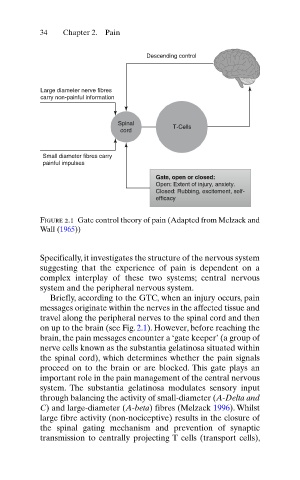
             Figure 2.1     Gate control theory of pain (Adapted from Melzack and
           Wall (  1965 ))


           Specifically, it investigates the structure of the nervous system
           suggesting that the experience of pain is dependent on a
             complex interplay of these two systems; central nervous
             system and the peripheral nervous system.
               Briefly, according to the GTC, when an injury occurs, pain
           messages originate within the nerves in the affected tissue and
           travel along the peripheral nerves to the spinal cord and then
           on up to the brain (see Fig.   2.1 ). However, before reaching the
           brain, the pain messages encounter a ‘gate keeper’ (a group of
           nerve cells known as the substantia gelatinosa situated within
           the spinal cord), which determines whether the pain signals
           proceed on to the brain or are blocked. This gate plays an
           important role in the pain management of the central nervous
           system.  The substantia gelatinosa modulates sensory input
           through balancing the activity of small- diameter ( A - Delta and
           C ) and large-diameter ( A - beta ) fibres (Melzack   1996 ). Whilst
           large fibre activity (non-nociceptive) results in the closure of
           the spinal gating mechanism and prevention of synaptic
            transmission to centrally projecting T cells ( transport cells),

