


Page 64 - Psychology of Wounds and Wound Care in Clinical Practice ( PDFDrive )
P. 64
Factors Influencing Pain  37


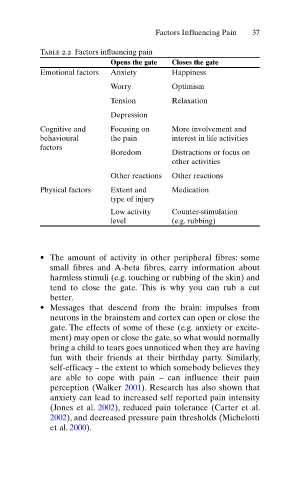
              Table 2.2    Factors influencing pain
                              Opens the gate     Closes the gate
            Emotional factors    Anxiety    Happiness
                             Worry         Optimism

                             Tension       Relaxation
                             Depression
            Cognitive and    Focusing on     More involvement and
           behavioural      the pain      interest in life activities
           factors
                              Boredom       Distractions or focus on
                                          other activities
                             Other reactions    Other reactions
            Physical factors    Extent and    Medication
                            type of injury
                             Low activity    Counter-stimulation
                            level         (e.g. rubbing)


           •    The amount of activity in other peripheral fibres: some
             small fibres and  A-beta fibres, carry information about
             harmless stimuli (e.g. touching or rubbing of the skin) and
             tend to close the gate.  This is why you can rub a cut
             better.
           •    Messages that descend from the brain: impulses from
               neurons in the brainstem and cortex can open or close the
             gate. The effects of some of these (e.g. anxiety or excite-
             ment) may open or close the gate, so what would normally
             bring a child to tears goes unnoticed when they are having
             fun with their friends at their birthday party. Similarly,
              self- efficacy – the extent to which somebody believes they
             are able to cope with pain – can influence their pain
               perception (Walker   2001 ). Research has also shown that
             anxiety can lead to increased self reported pain intensity
             (Jones et al.   2002 ), reduced pain tolerance (Carter et al.
               2002 ), and decreased pressure pain thresholds (Michelotti
             et al.   2000 ).

