


Page 161 - Clinical Anatomy
P. 161
ECA2  7/18/06  6:43 PM  Page 146


                 146  The abdomen and pelvis


                Structure

                The ovary has no peritoneal covering; the serosa ends at the mesovarian
                attachment. It consists of a connective tissue stroma containing Graafian fol-
                licles at various stages of development, corpora lutea and corpora albicantia
                (hyalinized, regressing corpora lutea, which take several months to absorb
                completely).
                   The surface of the ovary in young children is covered with a so-called
                ‘germinal epithelium’ of cuboidal cells. It is now known, however, that
                the primordial follicles develop in the ovary in early fetal life and do not
                differentiate from these cells. In adult life, in fact, the epithelial covering
                of the ovary disappears, leaving only a fibrous capsule termed the tunica
                albuginea.
                   After the menopause the ovary becomes small and shrivelled; in old age
                the follicles disappear completely.

                The endopelvic fascia and the pelvic
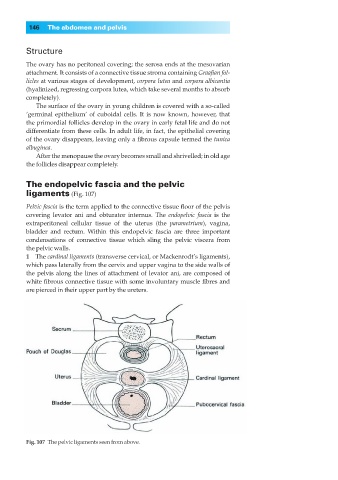
                ligaments (Fig. 107)
                Pelvic fascia is the term applied to the connective tissue floor of the pelvis
                covering levator ani and obturator internus. The  endopelvic fascia is the
                extraperitoneal cellular tissue of the uterus (the  parametrium), vagina,
                bladder and rectum. Within this endopelvic fascia are three important
                condensations of connective tissue which sling the pelvic viscera from
                the pelvic walls.
                1◊◊The cardinal ligaments (transverse cervical, or Mackenrodt’s ligaments),
                which pass laterally from the cervix and upper vagina to the side walls of
                the pelvis along the lines of attachment of levator ani, are composed of
                white fibrous connective tissue with some involuntary muscle fibres and
                are pierced in their upper part by the ureters.


                Fig. 107◊The pelvic ligaments seen from above.

