


Page 223 - Clinical Anatomy
P. 223
ECA4  7/18/06  6:47 PM  Page 208


                 208  The lower limb


                scrubbing floors or hewing coal (‘housemaid’s knee’, the ‘beat knee’ of
                north-country miners, or prepatellar bursitis); whereas the bursa over the
                ligamentum patellae is involved by years of kneeling in a more erect
                position —as in praying (‘clergyman’s knee’ or infrapatellar bursitis).
                Young women who affect fashionable but tight shoes are prone to bursitis
                over the insertion of the tendo Achillis into the calcaneus and may also
                develop bursae over the navicular tuberosity and dorsal aspects of the
                phalanges.
                   A‘bunion’ is a thickened bursa on the inner aspect of the first metatarsal
                head, usually associated with hallux valgus deformity. Note that this is an
                adventitial bursa; it is not present in normal subjects.


                Mensuration in the lower limb
                Measurement is an important part of the clinical examination of the lower
                limb. Unfortunately, students find difficulty in carrying this out accurately
                and still greater difficulty in explaining the results they obtain, yet this is
                nothing more or less than a simple exercise in applied anatomy.
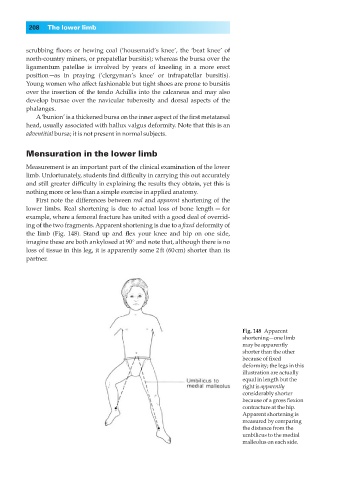
                   First note the differences between real and apparent shortening of the
                lower limbs. Real shortening is due to actual loss of bone length — for
                example, where a femoral fracture has united with a good deal of overrid-
                ing of the two fragments. Apparent shortening is due to a fixed deformity of
                the limb (Fig. 148). Stand up and flex your knee and hip on one side,
                imagine these are both ankylosed at 90° and note that, although there is no
                loss of tissue in this leg, it is apparently some 2ft (60cm) shorter than its
                partner.


                                                                              Fig. 148◊Apparent
                                                                              shortening—one limb
                                                                              may be apparently
                                                                              shorter than the other
                                                                              because of fixed
                                                                              deformity; the legs in this
                                                                              illustration are actually
                                                                              equal in length but the
                                                                              right is apparently
                                                                              considerably shorter
                                                                              because of a gross flexion
                                                                              contracture at the hip.
                                                                              Apparent shortening is
                                                                              measured by comparing
                                                                              the distance from the
                                                                              umbilicus to the medial
                                                                              malleolus on each side.

