


Page 224 - Clinical Anatomy
P. 224
ECA4  7/18/06  6:47 PM  Page 209


                                          The anatomy and surface markings of the lower limb   209


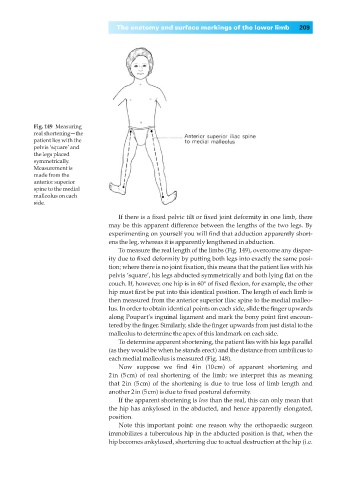
                  Fig. 149◊Measuring
                  real shortening—the
                  patient lies with the
                  pelvis ‘square’ and
                  the legs placed
                  symmetrically.
                  Measurement is
                  made from the
                  anterior superior
                  spine to the medial
                  malleolus on each
                  side.
                                          If there is a fixed pelvic tilt or fixed joint deformity in one limb, there
                                        may be this apparent difference between the lengths of the two legs. By
                                        experimenting on yourself you will find that adduction apparently short-
                                        ens the leg, whereas it is apparently lengthened in abduction.
                                          To measure the real length of the limbs (Fig. 149), overcome any dispar-
                                        ity due to fixed deformity by putting both legs into exactly the same posi-
                                        tion; where there is no joint fixation, this means that the patient lies with his
                                        pelvis ‘square’, his legs abducted symmetrically and both lying flat on the
                                        couch. If, however, one hip is in 60° of fixed flexion, for example, the other
                                        hip must first be put into this identical position. The length of each limb is
                                        then measured from the anterior superior iliac spine to the medial malleo-
                                        lus. In order to obtain identical points on each side, slide the finger upwards
                                        along Poupart’s inguinal ligament and mark the bony point first encoun-
                                        tered by the finger. Similarly, slide the finger upwards from just distal to the
                                        malleolus to determine the apex of this landmark on each side.
                                          To determine apparent shortening, the patient lies with his legs parallel
                                        (as they would be when he stands erect) and the distance from umbilicus to
                                        each medial malleolus is measured (Fig. 148).
                                          Now suppose we find 4in (10cm) of apparent shortening and
                                        2in (5cm) of real shortening of the limb; we interpret this as meaning
                                        that 2in (5cm) of the shortening is due to true loss of limb length and
                                        another 2in (5cm) is due to fixed postural deformity.
                                          If the apparent shortening is less than the real, this can only mean that
                                        the hip has ankylosed in the abducted, and hence apparently elongated,
                                        position.
                                          Note this important point: one reason why the orthopaedic surgeon
                                        immobilizes a tuberculous hip in the abducted position is that, when the
                                        hip becomes ankylosed, shortening due to actual destruction at the hip (i.e.

