


Page 225 - Clinical Anatomy
P. 225
ECA4  7/18/06  6:47 PM  Page 210


                 210  The lower limb


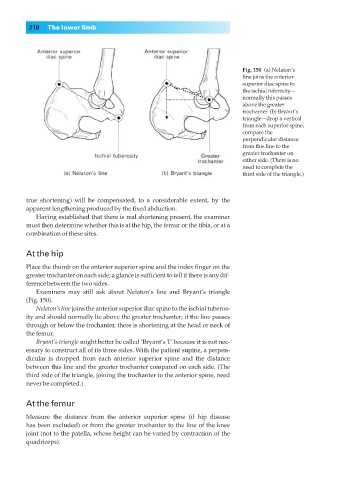
                                                                              Fig. 150◊(a) Nelaton’s
                                                                              line joins the anterior
                                                                              superior iliac spine to
                                                                              the ischial tuberosity—
                                                                              normally this passes
                                                                              above the greater
                                                                              trochanter. (b) Bryant’s
                                                                              triangle—drop a vertical
                                                                              from each superior spine;
                                                                              compare the
                                                                              perpendicular distance
                                                                              from this line to the
                                                                              greater trochanter on
                                                                              either side. (There is no
                                                                              need to complete the
                                                                              third side of the triangle.)


                true shortening) will be compensated, to a considerable extent, by the
                apparent lengthening produced by the fixed abduction.
                   Having established that there is real shortening present, the examiner
                must then determine whether this is at the hip, the femur or the tibia, or at a
                combination of these sites.


                At the hip
                Place the thumb on the anterior superior spine and the index finger on the
                greater trochanter on each side; a glance is sufficient to tell if there is any dif-
                ference between the two sides.
                   Examiners may still ask about Nelaton’s line and Bryant’s triangle
                (Fig. 150).
                   Nelaton’s line joins the anterior superior iliac spine to the ischial tuberos-
                ity and should normally lie above the greater trochanter; if the line passes
                through or below the trochanter, there is shortening at the head or neck of
                the femur.
                   Bryant’s triangle might better be called ‘Bryant’s T’ because it is not nec-
                essary to construct all of its three sides. With the patient supine, a perpen-
                dicular is dropped from each anterior superior spine and the distance
                between this line and the greater trochanter compared on each side. (The
                third side of the triangle, joining the trochanter to the anterior spine, need
                never be completed.)

                At the femur

                Measure the distance from the anterior superior spine (if hip disease
                has been excluded) or from the greater trochanter to the line of the knee
                joint (not to the patella, whose height can be varied by contraction of the
                quadriceps).

