


Page 228 - Clinical Anatomy
P. 228
ECA4  7/18/06  6:47 PM  Page 213


                                          The anatomy and surface markings of the lower limb   213


                                      Anterior superior iliac spine
                                                                                    Inguinal ligament


                                                                                    Midline


                                                                                    Femoral artery


                                                                                    Adductor hiatus in
                                                                                    adductor magnus
                                                                                    Popliteal artery


                                                                                    Adductor tubercle


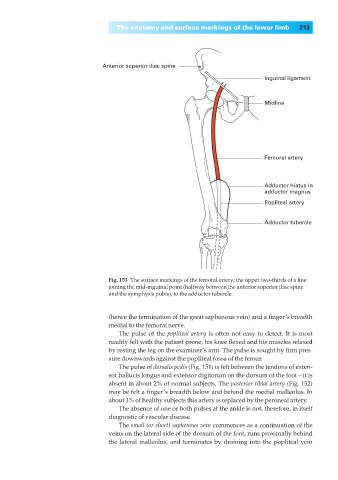
                                        Fig. 153◊The surface markings of the femoral artery; the upper two-thirds of a line
                                        joining the mid-inguinal point (halfway between the anterior superior iliac spine
                                        and the symphysis pubis), to the adductor tubercle.


                                        (hence the termination of the great saphenous vein) and a finger’s breadth
                                        medial to the femoral nerve.
                                          The pulse of the popliteal artery is often not easy to detect. It is most
                                        readily felt with the patient prone, his knee flexed and his muscles relaxed
                                        by resting the leg on the examiner’s arm. The pulse is sought by firm pres-
                                        sure downwards against the popliteal fossa of the femur.
                                          The pulse of dorsalis pedis (Fig. 151) is felt between the tendons of exten-
                                        sor hallucis longus and extensor digitorum on the dorsum of the foot—it is
                                        absent in about 2% of normal subjects. The posterior tibial artery (Fig. 152)
                                        may be felt a finger’s breadth below and behind the medial malleolus. In
                                        about 1% of healthy subjects this artery is replaced by the peroneal artery.
                                          The absence of one or both pulses at the ankle is not, therefore, in itself
                                        diagnostic of vascular disease.
                                          The small (or short) saphenous vein commences as a continuation of the
                                        veins on the lateral side of the dorsum of the foot, runs proximally behind
                                        the lateral malleolus, and terminates by draining into the popliteal vein

