


Page 241 - Clinical Anatomy
P. 241
ECA4  7/18/06  6:47 PM  Page 226


                 226  The lower limb


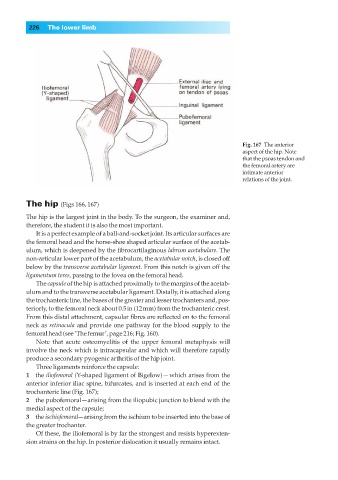
                                                                              Fig. 167◊The anterior
                                                                              aspect of the hip. Note
                                                                              that the psoas tendon and
                                                                              the femoral artery are
                                                                              intimate anterior
                                                                              relations of the joint.


                The hip (Figs 166, 167)
                The hip is the largest joint in the body. To the surgeon, the examiner and,
                therefore, the student it is also the most important.
                   It is a perfect example of a ball-and-socket joint. Its articular surfaces are
                the femoral head and the horse-shoe shaped articular surface of the acetab-
                ulum, which is deepened by the fibrocartilaginous labrum acetabulare. The
                non-articular lower part of the acetabulum, the acetabular notch, is closed off
                below by the transverse acetabular ligament. From this notch is given off the
                ligamentum teres, passing to the fovea on the femoral head.
                   The capsule of the hip is attached proximally to the margins of the acetab-
                ulum and to the transverse acetabular ligament. Distally, it is attached along
                the trochanteric line, the bases of the greater and lesser trochanters and, pos-
                teriorly, to the femoral neck about 0.5in (12mm) from the trochanteric crest.
                From this distal attachment, capsular fibres are reflected on to the femoral
                neck as retinacula and provide one pathway for the blood supply to the
                femoral head (see ‘The femur’, page 216; Fig. 160).
                   Note that acute osteomyelitis of the upper femoral metaphysis will
                involve the neck which is intracapsular and which will therefore rapidly
                produce a secondary pyogenic arthritis of the hip joint.
                   Three ligaments reinforce the capsule:
                1◊◊the iliofemoral (Y-shaped ligament of Bigelow) — which arises from the
                anterior inferior iliac spine, bifurcates, and is inserted at each end of the
                trochanteric line (Fig. 167);
                2◊◊the pubofemoral—arising from the iliopubic junction to blend with the
                medial aspect of the capsule;
                3◊◊the ischiofemoral—arising from the ischium to be inserted into the base of
                the greater trochanter.
                   Of these, the iliofemoral is by far the strongest and resists hyperexten-
                sion strains on the hip. In posterior dislocation it usually remains intact.

