


Page 237 - Clinical Anatomy
P. 237
ECA4  7/18/06  6:47 PM  Page 222


                 222  The lower limb


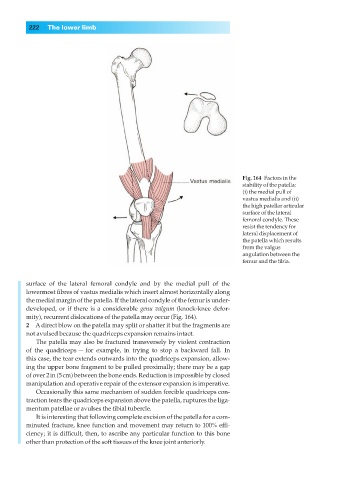
                                                                              Fig. 164◊Factors in the
                                                                              stability of the patella:
                                                                              (i) the medial pull of
                                                                              vastus medialis and (ii)
                                                                              the high patellar articular
                                                                              surface of the lateral
                                                                              femoral condyle. These
                                                                              resist the tendency for
                                                                              lateral displacement of
                                                                              the patella which results
                                                                              from the valgus
                                                                              angulation between the
                                                                              femur and the tibia.


                surface of the lateral femoral condyle and by the medial pull of the
                lowermost fibres of vastus medialis which insert almost horizontally along
                the medial margin of the patella. If the lateral condyle of the femur is under-
                developed, or if there is a considerable genu valgum (knock-knee defor-
                mity), recurrent dislocations of the patella may occur (Fig. 164).
                2◊◊A direct blow on the patella may split or shatter it but the fragments are
                not avulsed because the quadriceps expansion remains intact.
                   The patella may also be fractured transversely by violent contraction
                of the quadriceps — for example, in trying to stop a backward fall. In
                this case, the tear extends outwards into the quadriceps expansion, allow-
                ing the upper bone fragment to be pulled proximally; there may be a gap
                of over 2in (5cm) between the bone ends. Reduction is impossible by closed
                manipulation and operative repair of the extensor expansion is imperative.
                   Occasionally this same mechanism of sudden forcible quadriceps con-
                traction tears the quadriceps expansion above the patella, ruptures the liga-
                mentum patellae or avulses the tibial tubercle.
                   It is interesting that following complete excision of the patella for a com-
                minuted fracture, knee function and movement may return to 100% effi-
                ciency; it is difficult, then, to ascribe any particular function to this bone
                other than protection of the soft tissues of the knee joint anteriorly.

