


Page 262 - Clinical Anatomy
P. 262
ECA4  7/18/06  6:47 PM  Page 247


                                                                  The veins of the lower limb  247


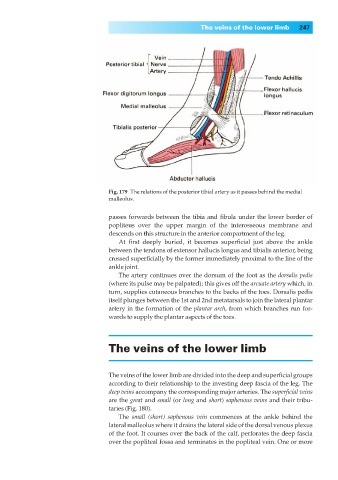
                                        Fig. 179◊The relations of the posterior tibial artery as it passes behind the medial
                                        malleolus.

                                        passes forwards between the tibia and fibula under the lower border of
                                        popliteus over the upper margin of the interosseous membrane and
                                        descends on this structure in the anterior compartment of the leg.
                                          At first deeply buried, it becomes superficial just above the ankle
                                        between the tendons of extensor hallucis longus and tibialis anterior, being
                                        crossed superficially by the former immediately proximal to the line of the
                                        ankle joint.
                                          The artery continues over the dorsum of the foot as the dorsalis pedis
                                        (where its pulse may be palpated); this gives off the arcuate artery which, in
                                        turn, supplies cutaneous branches to the backs of the toes. Dorsalis pedis
                                        itself plunges between the 1st and 2nd metatarsals to join the lateral plantar
                                        artery in the formation of the plantar arch, from which branches run for-
                                        wards to supply the plantar aspects of the toes.


                                        The veins of the lower limb


                                        The veins of the lower limb are divided into the deep and superficial groups
                                        according to their relationship to the investing deep fascia of the leg. The
                                        deep veins accompany the corresponding major arteries. The superficial veins
                                        are the great and small (or long and short) saphenous veins and their tribu-
                                        taries (Fig. 180).
                                          The  small (short) saphenous vein commences at the ankle behind the
                                        lateral malleolus where it drains the lateral side of the dorsal venous plexus
                                        of the foot. It courses over the back of the calf, perforates the deep fascia
                                        over the popliteal fossa and terminates in the popliteal vein. One or more

