


Page 267 - Clinical Anatomy
P. 267
ECA4  7/18/06  6:47 PM  Page 252


                 252  The lower limb


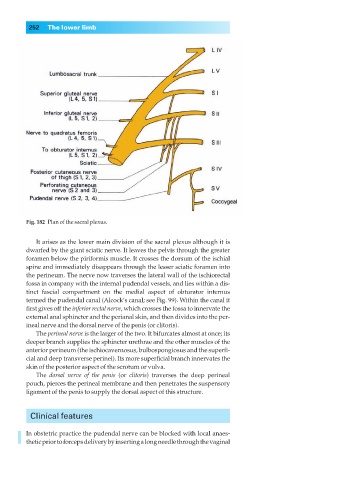
                Fig. 182◊Plan of the sacral plexus.


                   It arises as the lower main division of the sacral plexus although it is
                dwarfed by the giant sciatic nerve. It leaves the pelvis through the greater
                foramen below the piriformis muscle. It crosses the dorsum of the ischial
                spine and immediately disappears through the lesser sciatic foramen into
                the perineum. The nerve now traverses the lateral wall of the ischiorectal
                fossa in company with the internal pudendal vessels, and lies within a dis-
                tinct fascial compartment on the medial aspect of obturator internus
                termed the pudendal canal (Alcock’s canal; see Fig. 99). Within the canal it
                first gives off the inferior rectal nerve, which crosses the fossa to innervate the
                external anal sphincter and the perianal skin, and then divides into the per-
                ineal nerve and the dorsal nerve of the penis (or clitoris).
                   The perineal nerve is the larger of the two. It bifurcates almost at once; its
                deeper branch supplies the sphincter urethrae and the other muscles of the
                anterior perineum (the ischiocavernosus, bulbospongiosus and the superfi-
                cial and deep transverse perinei). Its more superficial branch innervates the
                skin of the posterior aspect of the scrotum or vulva.
                   The  dorsal nerve of the penis (or  clitoris) traverses the deep perineal
                pouch, pierces the perineal membrane and then penetrates the suspensory
                ligament of the penis to supply the dorsal aspect of this structure.


                 Clinical features

                In obstetric practice the pudendal nerve can be blocked with local anaes-
                thetic prior to forceps delivery by inserting a long needle through the vaginal

