


Page 415 - Clinical Anatomy
P. 415
ECA6  7/18/06  6:54 PM  Page 400


                 400  The central nervous system


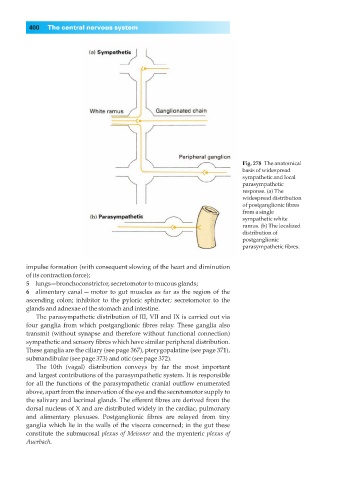
                                                                              Fig. 278◊The anatomical
                                                                              basis of widespread
                                                                              sympathetic and local
                                                                              parasympathetic
                                                                              response. (a) The
                                                                              widespread distribution
                                                                              of postganglionic fibres
                                                                              from a single
                                                                              sympathetic white
                                                                              ramus. (b) The localized
                                                                              distribution of
                                                                              postganglionic
                                                                              parasympathetic fibres.


                impulse formation (with consequent slowing of the heart and diminution
                of its contraction force);
                5◊◊lungs—bronchoconstrictor, secretomotor to mucous glands;
                6◊◊alimentary canal — motor to gut muscles as far as the region of the
                ascending colon; inhibitor to the pyloric sphincter; secretomotor to the
                glands and adnexae of the stomach and intestine.
                   The parasympathetic distribution of III, VII and IX is carried out via
                four ganglia from which postganglionic fibres relay. These ganglia also
                transmit (without synapse and therefore without functional connection)
                sympathetic and sensory fibres which have similar peripheral distribution.
                These ganglia are the ciliary (see page 367), pterygopalatine (see page 371),
                submandibular (see page 373) and otic (see page 372).
                   The 10th (vagal) distribution conveys by far the most important
                and largest contributions of the parasympathetic system. It is responsible
                for all the functions of the parasympathetic cranial outflow enumerated
                above, apart from the innervation of the eye and the secretomotor supply to
                the salivary and lacrimal glands. The efferent fibres are derived from the
                dorsal nucleus of X and are distributed widely in the cardiac, pulmonary
                and alimentary plexuses. Postganglionic fibres are relayed from tiny
                ganglia which lie in the walls of the viscera concerned; in the gut these
                constitute the submucosal plexus of Meissner and the myenteric plexus of
                Auerbach.

