


Page 412 - Clinical Anatomy
P. 412
ECA6  7/18/06  6:54 PM  Page 397


                                                              The autonomic nervous system     397


                                        descends in a groove between psoas major and the sides of the lumbar verte-
                                        bral bodies, overlapped by the abdominal aorta on the left and the inferior
                                        vena cava on the right. The chain then passes behind the common iliac
                                        vessels to enter the pelvis anterior to the ala of the sacrum and then descends
                                        medial to the anterior sacral foramina. The sympathetic trunks end below by
                                        meeting each other at the ganglion imparon the anterior face of the coccyx.
                                          The details of the cervical, thoracic and lumbar portions of the trunk are
                                        given on pages 331, 47 and 153 respectively.
                                          The sympathetic trunk bears a series of ganglia along its course which
                                        contain motor cells with which preganglionic medullated fibres enter into
                                        synapse and from which non-medullated postganglionic axons originate.
                                        Developmentally, there was originally one ganglion for each peripheral
                                        nerve, but by a process of fusion these have been reduced in man to three cer-
                                        vical, twelve or less thoracic, two to four lumbar and four sacral ganglia.
                                        Only the ganglia of T1 to L2 receive white rami directly; the higher and lower
                                        ganglia must receive their preganglionic supply from medullated nerves
                                        which travel through their corresponding ganglia without relay and which
                                        then ascend or descend in the sympathetic chain. Still other preganglionic
                                        fibres pass intact through the ganglia to peripheral visceral ganglia for relay.
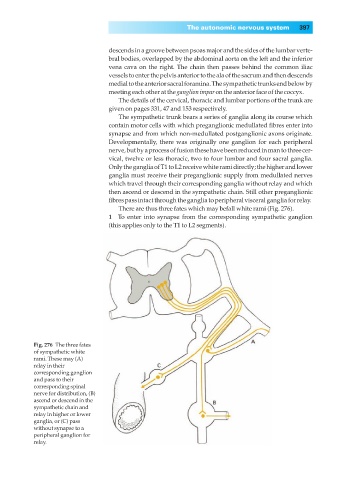
                                          There are thus three fates which may befall white rami (Fig. 276).
                                        1◊◊To  enter into synapse from the corresponding sympathetic ganglion
                                        (this applies only to the T1 to L2 segments).


                  Fig. 276◊The three fates
                  of sympathetic white
                  rami. These may (A)
                  relay in their
                  corresponding ganglion
                  and pass to their
                  corresponding spinal
                  nerve for distribution, (B)
                  ascend or descend in the
                  sympathetic chain and
                  relay in higher or lower
                  ganglia, or (C) pass
                  without synapse to a
                  peripheral ganglion for
                  relay.

