


Page 414 - Clinical Anatomy
P. 414
ECA6  7/18/06  6:54 PM  Page 399


                                                              The autonomic nervous system     399


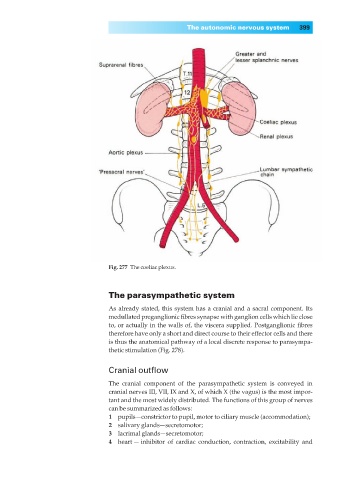
                                        Fig. 277◊The coeliac plexus.


                                        The parasympathetic system

                                        As already stated, this system has a cranial and a sacral component. Its
                                        medullated preganglionic fibres synapse with ganglion cells which lie close
                                        to, or actually in the walls of, the viscera supplied. Postganglionic fibres
                                        therefore have only a short and direct course to their effector cells and there
                                        is thus the anatomical pathway of a local discrete response to parasympa-
                                        thetic stimulation (Fig. 278).

                                        Cranial outflow

                                        The cranial component of the parasympathetic system is conveyed in
                                        cranial nerves III, VII, IX and X, of which X (the vagus) is the most impor-
                                        tant and the most widely distributed. The functions of this group of nerves
                                        can be summarized as follows:
                                        1◊◊pupils—constrictor to pupil, motor to ciliary muscle (accommodation);
                                        2◊◊salivary glands—secretomotor;
                                        3◊◊lacrimal glands—secretomotor;
                                        4◊◊heart — inhibitor of cardiac conduction, contraction, excitability and

