


Page 410 - Clinical Anatomy
P. 410
ECA6  7/18/06  6:54 PM  Page 395


                                                              The autonomic nervous system     395


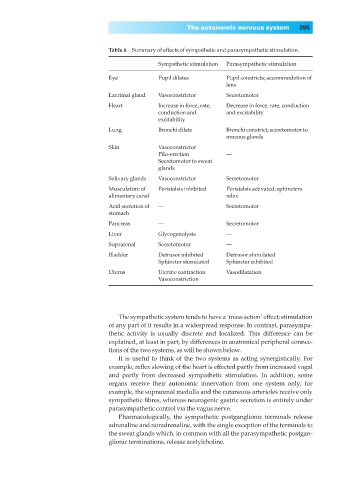
                                        Table 6◊◊Summary of effects of sympathetic and parasympathetic stimulation.

                                                      Sympathetic stimulation  Parasympathetic stimulation
                                        Eye           Pupil dilates      Pupil constricts; accommodation of
                                                                         lens
                                        Lacrimal gland  Vasoconstrictor  Secretomotor
                                        Heart         Increase in force, rate,  Decrease in force, rate, conduction
                                                      conduction and     and excitability
                                                      excitability
                                        Lung          Bronchi dilate     Bronchi constrict; secretomotor to
                                                                         mucous glands
                                        Skin          Vasoconstrictor
                                                      Pilo-erection      —
                                                      Secretomotor to sweat
                                                      glands
                                        Salivary glands  Vasoconstrictor  Secretomotor
                                        Musculature of   Peristalsis inhibited  Peristalsis activated; sphincters
                                        alimentary canal                 relax
                                        Acid secretion of   —            Secretomotor
                                        stomach
                                        Pancreas      —                  Secretomotor
                                        Liver         Glycogenolysis     —
                                        Suprarenal    Secretomotor       —
                                        Bladder       Detrusor inhibited  Detrusor stimulated
                                                      Sphincter stimulated  Sphincter inhibited
                                        Uterus        Uterine contraction  Vasodilatation
                                                      Vasoconstriction


                                          The sympathetic system tends to have a ‘mass action’ effect; stimulation
                                        of any part of it results in a widespread response. In contrast, parasympa-
                                        thetic activity is usually discrete and localized. This difference can be
                                        explained, at least in part, by differences in anatomical peripheral connec-
                                        tions of the two systems, as will be shown below.
                                          It is useful to think of the two systems as acting synergistically. For
                                        example, reflex slowing of the heart is effected partly from increased vagal
                                        and partly from decreased sympathetic stimulation. In addition, some
                                        organs receive their autonomic innervation from one system only; for
                                        example, the suprarenal medulla and the cutaneous arterioles receive only
                                        sympathetic fibres, whereas neurogenic gastric secretion is entirely under
                                        parasympathetic control via the vagus nerve.
                                          Pharmacologically, the sympathetic postganglionic terminals release
                                        adrenaline and noradrenaline, with the single exception of the terminals to
                                        the sweat glands which, in common with all the parasympathetic postgan-
                                        glionic terminations, release acetylcholine.

