


Page 90 - Clinical Anatomy
P. 90
ECA2  7/18/06  6:42 PM  Page 75


                                                                    The gastrointestinal tract  75


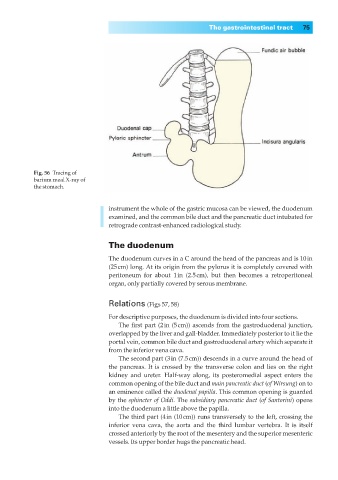
                  Fig. 56◊Tracing of
                  barium meal X-ray of
                  the stomach.


                                        instrument the whole of the gastric mucosa can be viewed, the duodenum
                                        examined, and the common bile duct and the pancreatic duct intubated for
                                        retrograde contrast-enhanced radiological study.


                                        The duodenum
                                        The duodenum curves in a C around the head of the pancreas and is 10in
                                        (25cm) long. At its origin from the pylorus it is completely covered with
                                        peritoneum for about 1in (2.5cm), but then becomes a retroperitoneal
                                        organ, only partially covered by serous membrane.


                                        Relations (Figs 57, 58)
                                        For descriptive purposes, the duodenum is divided into four sections.
                                          The first part (2in (5cm)) ascends from the gastroduodenal junction,
                                        overlapped by the liver and gall-bladder. Immediately posterior to it lie the
                                        portal vein, common bile duct and gastroduodenal artery which separate it
                                        from the inferior vena cava.
                                          The second part (3in (7.5cm)) descends in a curve around the head of
                                        the pancreas. It is crossed by the transverse colon and lies on the right
                                        kidney and ureter. Half-way along, its posteromedial aspect enters the
                                        common opening of the bile duct and main pancreatic duct (of Wirsung) on to
                                        an eminence called the duodenal papilla. This common opening is guarded
                                        by the sphincter of Oddi. The subsidiary pancreatic duct (of Santorini) opens
                                        into the duodenum a little above the papilla.
                                          The third part (4in (10cm)) runs transversely to the left, crossing the
                                        inferior vena cava, the aorta and the third lumbar vertebra. It is itself
                                        crossed anteriorly by the root of the mesentery and the superior mesenteric
                                        vessels. Its upper border hugs the pancreatic head.

