


Page 85 - Clinical Anatomy
P. 85
ECA2  7/18/06  6:42 PM  Page 70


                 70  The abdomen and pelvis


                through the bed of, the 12th rib. A finger is then passed upwards and for-
                wards between liver and diaphragm to open into the abscess cavity. An
                anteriorly placed collection of pus below the diaphragm can alternatively
                be drained via an incision placed below and parallel to the costal margin.
                Nowadays, intra-abdominal fluid collections can often be drained percuta-
                neously under ultrasound or CT control.


                The gastrointestinal tract


                The stomach
                The stomach is roughly J-shaped, although its size and shape vary consid-
                erably. It tends to be high and transverse in the obese short subject and to be
                elongated in the asthenic individual; even in the same person, its shape
                depends on whether it is full or empty, on the position of the body and on
                the phase of respiration. The stomach has two surfaces — the anterior and
                posterior; two curvatures — the greater and lesser; and two orifices — the
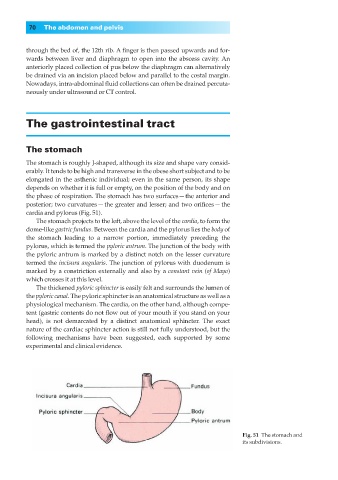
                cardia and pylorus (Fig. 51).
                   The stomach projects to the left, above the level of the cardia, to form the
                dome-like gastric fundus. Between the cardia and the pylorus lies the body of
                the stomach leading to a narrow portion, immediately preceding the
                pylorus, which is termed the pyloric antrum. The junction of the body with
                the pyloric antrum is marked by a distinct notch on the lesser curvature
                termed the incisura angularis. The junction of pylorus with duodenum is
                marked by a constriction externally and also by a constant vein (of Mayo)
                which crosses it at this level.
                   The thickened pyloric sphincter is easily felt and surrounds the lumen of
                the pyloric canal. The pyloric sphincter is an anatomical structure as well as a
                physiological mechanism. The cardia, on the other hand, although compe-
                tent (gastric contents do not flow out of your mouth if you stand on your
                head), is not demarcated by a distinct anatomical sphincter. The exact
                nature of the cardiac sphincter action is still not fully understood, but the
                following mechanisms have been suggested, each supported by some
                experimental and clinical evidence.


                                                                              Fig. 51◊The stomach and
                                                                              its subdivisions.

