


Page 86 - Clinical Anatomy
P. 86
ECA2  7/18/06  6:42 PM  Page 71


                                                                    The gastrointestinal tract  71


                                        1◊◊Mucosal folds at the oesophagogastric junction act as a valve.
                                        2◊◊The acute angle of entry of oesophagus into stomach produces a valve-
                                        like effect.
                                        3◊◊The circular muscle of the lower oesophagus is a physiological, as dis-
                                        tinct from an anatomical, sphincter.
                                        4◊◊The arrangement of the muscle fibres of the stomach around the cardia
                                        acts either as a sphincter or else maintains the acute angle of entry of
                                        oesophagus into stomach.
                                        5◊◊The right crus of the diaphragm acts as a ‘pinch-cock’ to the lower
                                        oesophagus as it pierces this muscle.
                                        6◊◊The positive intra-abdominal pressure compresses the walls of the short
                                        segment of intra-abdominal oesophagus.

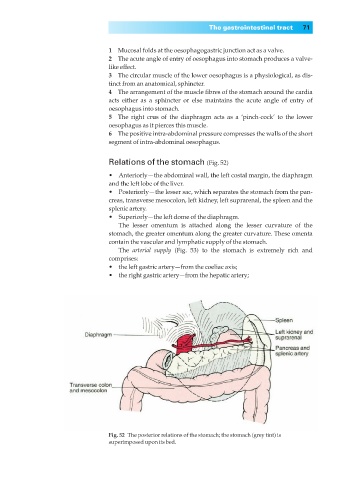
                                        Relations of the stomach (Fig. 52)

                                        •◊◊Anteriorly— the abdominal wall, the left costal margin, the diaphragm
                                        and the left lobe of the liver.
                                        •◊◊Posteriorly—the lesser sac, which separates the stomach from the pan-
                                        creas, transverse mesocolon, left kidney, left suprarenal, the spleen and the
                                        splenic artery.
                                        •◊◊Superiorly—the left dome of the diaphragm.
                                          The lesser omentum is attached along the lesser curvature of the
                                        stomach, the greater omentum along the greater curvature. These omenta
                                        contain the vascular and lymphatic supply of the stomach.
                                          The  arterial supply (Fig. 53) to the stomach is extremely rich and
                                        comprises:
                                        •◊◊the left gastric artery—from the coeliac axis;
                                        •◊◊the right gastric artery—from the hepatic artery;


                                        Fig. 52◊The posterior relations of the stomach; the stomach (grey tint) is
                                        superimposed upon its bed.

