


Page 26 - Critical Care Notes
P. 26
4223_Tab01_001-044  29/08/14  10:46 AM  Page 20


           BASICS

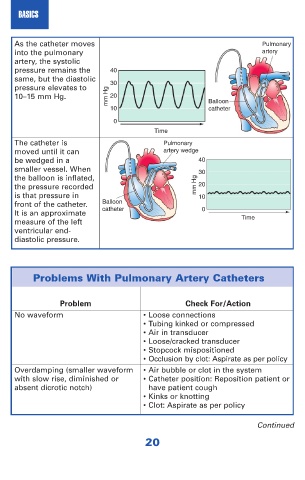
           As the catheter moves                    Pulmonary
           into the pulmonary                       artery
           artery, the systolic
           pressure remains the   40
           same, but the diastolic
           pressure elevates to
                          20
           10–15 mm Hg.   mm Hg 30         Balloon
                          10               catheter
                           0
                                  Time
           The catheter is         Pulmonary
           moved until it can      artery wedge
           be wedged in a                40
           smaller vessel. When
           the balloon is inflated,
                                         20
           the pressure recorded         mm Hg 30
           is that pressure in           10
           front of the catheter.   Balloon
           It is an approximate   catheter  0
           measure of the left                  Time
           ventricular end-
           diastolic pressure.
              Problems With Pulmonary Artery Catheters

                  Problem              Check For/Action
           No waveform          • Loose connections
                                • Tubing kinked or compressed
                                • Air in transducer
                                • Loose/cracked transducer
                                • Stopcock mispositioned
                                • Occlusion by clot: Aspirate as per policy
           Overdamping (smaller waveform   • Air bubble or clot in the system
           with slow rise, diminished or   • Catheter position: Reposition patient or
           absent dicrotic notch)  have patient cough
                                • Kinks or knotting
                                • Clot: Aspirate as per policy
                                                   Continued
                                20

