


Page 107 - Clinical Application of Mechanical Ventilation
P. 107
Classification of Mechanical Ventilators  73


                                 Pressure (cm H 2 O)  50                    50
                                  40
                                  30
                                  20
                                                                            40
                                  10
                                                                            30
                                                                            20
                                            1      2      3     4
                                                                          Flow (L/min)  1   2      3      4
                                                  Time (sec)                10


                                  1.0                                       10                           Time (sec)
                                                                            20
                                 Volume (L)                                 30

                                                                            40
                                                                            50
                                                                                                                   © Cengage Learning 2014


                                            1     2      3      4
                                                  Time (sec)
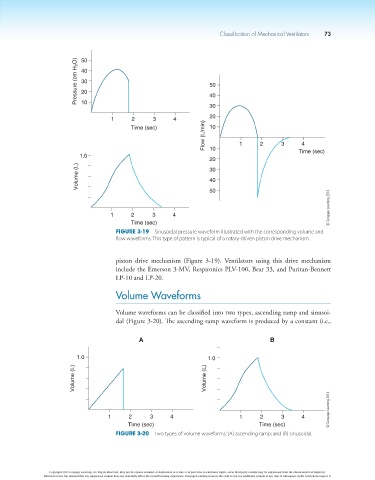
                                             Figure 3-19  Sinusoidal pressure waveform illustrated with the corresponding volume and
                                             flow waveforms. This type of pattern is typical of a rotary-driven piston drive mechanism.


                                             piston  drive  mechanism  (Figure  3-19).  Ventilators  using  this  drive  mechanism
                                             include the Emerson 3-MV, Respironics PLV-100, Bear 33, and Puritan-Bennett
                                             LP-10 and LP-20.

                                             Volume Waveforms


                                             Volume waveforms can be classified into two types, ascending ramp and sinusoi-
                                             dal (Figure 3-20). The ascending ramp waveform is produced by a constant (i.e.,


                                                     A                                          B

                                 1.0                                       1.0
                                Volume (L)                                 Volume (L)


                                                                                                                   © Cengage Learning 2014


                                           1      2      3     4                      1     2      3      4
                                                 Time (sec)                                 Time (sec)
                                             Figure 3-20  Two types of volume waveforms: (A) ascending ramp; and (B) sinusoidal.


                        Copyright 2013 Cengage Learning. All Rights Reserved. May not be copied, scanned, or duplicated, in whole or in part. Due to electronic rights, some third party content may be suppressed from the eBook and/or eChapter(s).
                      Editorial review has deemed that any suppressed content does not materially affect the overall learning experience. Cengage Learning reserves the right to remove additional content at any time if subsequent rights restrictions require it.

