


Page 104 - Clinical Application of Mechanical Ventilation
P. 104
70     Chapter 3


                                                                P high
                                             15

                                                                                                                 © Cengage Learning 2014
                                              5     R                                  P low
                                              0
                                                                          s                       s

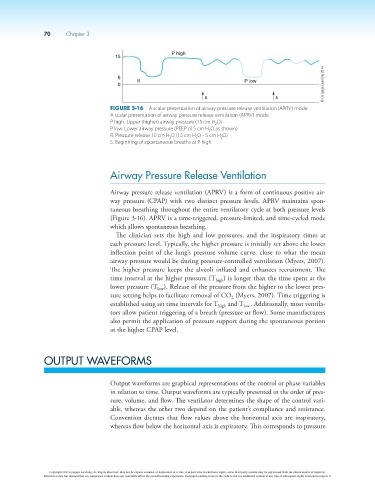
                                            Figure 3-16  A scalar presentation of airway pressure release ventilation (APRV) mode.
                                            A scalar presentation of airway pressure release ventilation (APRV) mode.
                                            P high. Upper (higher) airway pressure (15 cm H 2 O)
                                            P low. Lower airway pressure (PEEP of 5 cm H 2 O as shown)
                                            R. Pressure release 10 cm H 2 O (15 cm H 2 O - 5 cm H 2 O)
                                            S. Beginning of spontaneous breaths at P high


                                            Airway Pressure Release Ventilation


                                            Airway pressure release ventilation (APRV) is a form of continuous positive air-
                                            way  pressure  (CPAP)  with  two  distinct  pressure  levels.  APRV  maintains  spon-
                                            taneous breathing throughout the entire ventilatory cycle at both pressure levels
                                            (Figure 3-16). APRV is a time-triggered, pressure-limited, and time-cycled mode
                                            which allows spontaneous breathing.
                                             The  clinician  sets  the  high  and  low  pressures,  and  the  inspiratory  times  at
                                            each pressure level. Typically, the higher pressure is initially set above the lower
                                            inflection  point  of  the  lung’s  pressure  volume  curve,  close  to  what  the  mean
                                            airway pressure would be during pressure-controlled ventilation (Myers, 2007).
                                            The  higher  pressure  keeps  the  alveoli  inflated  and  enhances  recruitment.  The
                                            time interval at the higher pressure (T high ) is longer than the time spent at the
                                            lower pressure (T ). Release of the pressure from the higher to the lower pres-
                                                           low
                                            sure setting helps to facilitate removal of CO  (Myers, 2007). Time triggering is
                                                                                   2
                                            established using set time intervals for T high  and T low  . Additionally, most ventila-
                                            tors allow patient triggering of a breath (pressure or flow). Some manufacturers
                                            also permit the application of pressure support during the spontaneous portion
                                            at the higher CPAP level.


                      OUTPUT WAVEFORMS


                                            Output waveforms are graphical representations of the control or phase variables
                                            in relation to time. Output waveforms are typically presented in the order of pres-
                                            sure, volume, and flow. The ventilator determines the shape of the control vari-
                                            able, whereas the other two depend on the patient’s compliance and resistance.
                                            Convention  dictates  that  flow  values  above  the  horizontal  axis  are  inspiratory,
                                            whereas flow below the horizontal axis is expiratory. This corresponds to pressure


                        Copyright 2013 Cengage Learning. All Rights Reserved. May not be copied, scanned, or duplicated, in whole or in part. Due to electronic rights, some third party content may be suppressed from the eBook and/or eChapter(s).
                      Editorial review has deemed that any suppressed content does not materially affect the overall learning experience. Cengage Learning reserves the right to remove additional content at any time if subsequent rights restrictions require it.

