


Page 147 - Clinical Application of Mechanical Ventilation
P. 147
Operating Modes of Mechanical Ventilation  113


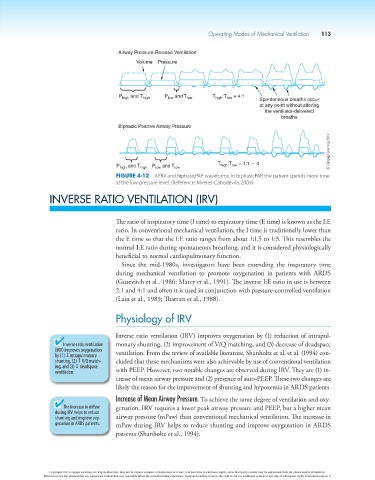
                                              Airway Pressure-Release Ventilation
                                                    Volume  Pressure


                                              P high  and T high  P low  and T low  T high :T low  = 4:1   Spontaneous breaths occur
                                                                                            at any point without altering
                                                                                              the ventilator-delivered
                                                                                                   breaths
                                              Biphasic Positive Airway Pressure
                                                                                                                   © Cengage Learning 2014


                                              P high  and T high  P low  and T low  T high :T low  = 1:1 2 4
                                             Figure 4-12  APRV and BiphasicPAP waveforms. In biphasicPAP, the patient spends more time
                                             at the low pressure level. (Reference: Mireles-Cabodevila, 2009)
                        INVERSE RATIO VENTILATION (IRV)


                                             The ratio of inspiratory time (I time) to expiratory time (E time) is known as the I:E
                                             ratio. In conventional mechanical ventilation, the I time is traditionally lower than
                                             the E time so that the I:E ratio ranges from about 1:1.5 to 1:3. This resembles the
                                             normal I:E ratio during spontaneous breathing, and it is considered physiologically
                                             beneficial to normal cardiopulmonary function.
                                               Since  the  mid-1980s,  investigators  have  been  extending  the  inspiratory  time
                                             during  mechanical  ventilation  to  promote  oxygenation  in  patients  with  ARDS
                                             (Gurevitch et al., 1986; Marcy et al., 1991). The inverse I:E ratio in use is between
                                             2:1 and 4:1 and often it is used in conjunction with pressure-controlled ventilation
                                             (Lain et al., 1989; Tharratt et al., 1988).


                                             Physiology of IRV


                                             Inverse ratio ventilation (IRV) improves oxygenation by (1) reduction of intrapul-
                            Inverse ratio ventilation   monary shunting, (2) improvement of V/Q matching, and (3) decrease of deadspace
                          (IRV) improves oxygenation   ventilation. From the review of available literature, Shanholtz et al. et al. (1994) con-
                          by (1)   intrapulmonary
                             ➞
                          shunting, (2)  ➞   V/Q match-  cluded that these mechanisms were also achievable by use of conventional ventilation
                          ing, and (3)   deadspace
                                ➞
                          ventilation.       with PEEP. However, two notable changes are observed during IRV. They are (1) in-
                                             crease of mean airway pressure and (2) presence of auto-PEEP. These two changes are
                                             likely the reason for the improvement of shunting and hypoxemia in ARDS patients.
                                             Increase of Mean Airway Pressure. To achieve the same degree of ventilation and oxy-
                            The increase in mPaw   genation, IRV requires a lower peak airway pressure and PEEP, but a higher mean
                          during IRV helps to reduce
                          shunting and improve oxy-  airway pressure (mPaw) than conventional mechanical ventilation. The increase in
                          genation in ARDS patients.  mPaw during IRV helps to reduce shunting and improve oxygenation in ARDS
                                             patients (Shanholtz et al., 1994).


                        Copyright 2013 Cengage Learning. All Rights Reserved. May not be copied, scanned, or duplicated, in whole or in part. Due to electronic rights, some third party content may be suppressed from the eBook and/or eChapter(s).
                      Editorial review has deemed that any suppressed content does not materially affect the overall learning experience. Cengage Learning reserves the right to remove additional content at any time if subsequent rights restrictions require it.

