


Page 144 - Clinical Application of Mechanical Ventilation
P. 144
110    Chapter 4


                                                    40          A                    B
                                                    35
                                                   Airway Pressure (cm H 2 O)  25
                                                    30

                                                    20
                                                    15
                                                    10
                                                                                                            © Cengage Learning 2014
                                                     5
                                                     0


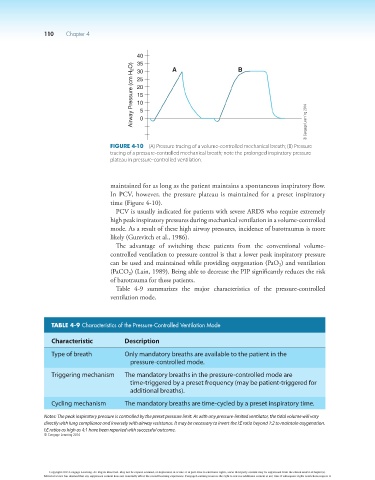
                                            Figure 4-10  (A) Pressure tracing of a volume-controlled mechanical breath; (B) Pressure
                                            tracing of a pressure-controlled mechanical breath; note the prolonged inspiratory pressure
                                            plateau in pressure-controlled ventilation.


                                            maintained for as long as the patient maintains a spontaneous inspiratory flow.
                                            In PCV, however, the pressure plateau is maintained for a preset inspiratory
                                            time (Figure 4-10).
                                             PCV is usually indicated for patients with severe ARDS who require extremely
                                            high peak inspiratory pressures during mechanical ventilation in a volume-controlled
                                            mode. As a result of these high airway pressures, incidence of barotraumas is more
                                            likely (Gurevitch et al., 1986).
                                             The  advantage  of  switching  these  patients  from  the  conventional  volume-
                                            controlled ventilation to pressure control is that a lower peak inspiratory pressure
                                            can be used and maintained while providing oxygenation (PaO ) and ventilation
                                                                                                   2
                                            (PaCO ) (Lain, 1989). Being able to decrease the PIP significantly reduces the risk
                                                  2
                                            of barotrauma for these patients.
                                             Table  4-9  summarizes  the  major  characteristics  of  the  pressure-controlled
                                            ventilation mode.


                        TABLE 4-9 Characteristics of the Pressure-Controlled Ventilation Mode

                        Characteristic          Description

                        Type of breath          Only mandatory breaths are available to the patient in the
                                                  pressure-controlled mode.

                        Triggering mechanism    The mandatory breaths in the pressure-controlled mode are
                                                  time-triggered by a preset frequency (may be patient-triggered for
                                                  additional breaths).

                        Cycling mechanism       The mandatory breaths are time-cycled by a preset inspiratory time.
                      Notes: The peak inspiratory pressure is controlled by the preset pressure limit. As with any pressure-limited ventilator, the tidal volume will vary
                      directly with lung compliance and inversely with airway resistance. It may be necessary to invert the I:E ratio beyond 1:2 to maintain oxygenation.
                      I:E ratios as high as 4:1 have been reported with successful outcome.
                      © Cengage Learning 2014


                        Copyright 2013 Cengage Learning. All Rights Reserved. May not be copied, scanned, or duplicated, in whole or in part. Due to electronic rights, some third party content may be suppressed from the eBook and/or eChapter(s).
                      Editorial review has deemed that any suppressed content does not materially affect the overall learning experience. Cengage Learning reserves the right to remove additional content at any time if subsequent rights restrictions require it.

