


Page 146 - Clinical Application of Mechanical Ventilation
P. 146
112    Chapter 4


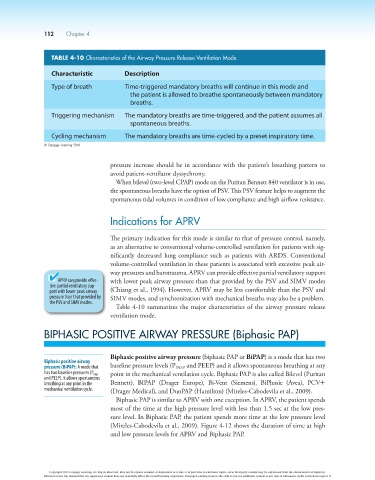
                        TABLE 4-10 Characteristics of the Airway Pressure Release Ventilation Mode

                        Characteristic          Description

                        Type of breath          Time-triggered mandatory breaths will continue in this mode and
                                                  the patient is allowed to breathe spontaneously between mandatory
                                                  breaths.

                        Triggering mechanism    The mandatory breaths are time-triggered, and the patient assumes all
                                                  spontaneous breaths.

                        Cycling mechanism       The mandatory breaths are time-cycled by a preset inspiratory time.
                      © Cengage Learning 2014


                                            pressure increase should be in accordance with the patient’s breathing pattern to
                                            avoid patient-ventilator dyssychrony.
                                             When bilevel (two-level CPAP) mode on the Puritan Bennett 840 ventilator is in use,
                                            the spontaneous breaths have the option of PSV. This PSV feature helps to augment the
                                            spontaneous tidal volumes in condition of low compliance and high airflow resistance.


                                            Indications for APRV


                                            The primary indication for this mode is similar to that of pressure control, namely,
                                            as an alternative to conventional volume-controlled ventilation for patients with sig-
                                            nificantly decreased lung compliance such as patients with ARDS. Conventional
                                            volume-controlled ventilation in these patients is associated with excessive peak air-
                                            way pressures and barotrauma. APRV can provide effective partial ventilatory support
                          APRV can provide effec-  with lower peak airway pressure than that provided by the PSV and SIMV modes
                        tive partial ventilatory sup-
                        port with lower peak airway   (Chiang et al., 1994). However, APRV may be less comfortable than the PSV and
                        pressure than that provided by   SIMV modes, and synchronization with mechanical breaths may also be a problem.
                        the PSV and SIMV modes.
                                             Table 4-10 summarizes the major characteristics of the airway pressure release
                                            ventilation mode.

                      BIPHASIC POSITIVE AIRWAY PRESSURE (Biphasic PAP)


                                            Biphasic positive airway pressure (biphasic PAP or BiPAP) is a mode that has two
                      Biphasic positive airway
                      pressure (BiPAP): A mode that   baseline pressure levels (P INSP  and PEEP) and it allows spontaneous breathing at any
                      has two baseline pressures (P insp    point in the mechanical ventilation cycle. Biphasic PAP is also called Bilevel (Puritan
                      and PEEP). It allows spontaneous
                      breathing at any point in the   Bennett),  BIPAP  (Drager  Europe),  Bi-Vent  (Siemens),  BiPhasic  (Avea),  PCV1
                      mechanical ventilation cycle.  (Drager Medical), and DuoPAP (Hamilton) (Mireles-Cabodevila et al., 2009).
                                             Biphasic PAP is similar to APRV with one exception. In APRV, the patient spends
                                            most of the time at the high pressure level with less than 1.5 sec at the low pres-
                                            sure level. In Biphasic PAP, the patient spends more time at the low pressure level
                                            (Mireles-Cabodevila et al., 2009). Figure 4-12 shows the duration of time at high
                                            and low pressure levels for APRV and Biphasic PAP.


                        Copyright 2013 Cengage Learning. All Rights Reserved. May not be copied, scanned, or duplicated, in whole or in part. Due to electronic rights, some third party content may be suppressed from the eBook and/or eChapter(s).
                      Editorial review has deemed that any suppressed content does not materially affect the overall learning experience. Cengage Learning reserves the right to remove additional content at any time if subsequent rights restrictions require it.

