


Page 145 - Clinical Application of Mechanical Ventilation
P. 145
Operating Modes of Mechanical Ventilation  111


                        AIRWAY PRESSURE RELEASE VENTILATION (APRV)


                                             Airway pressure release ventilation (APRV) has two CPAP or pressure levels—high
                        airway pressure release
                        ventilation (APRV): A mode of   pressure (P high  or P INSP ) and low pressure (P  or PEEP), and the patient is allowed
                                                                                  low
                        ventilation in which the spontane-  to breathe spontaneously without restriction. When the high pressure (P  ) level is
                        ous breaths are at an elevated                                                    high
                        baseline (i.e., CPAP). This elevated   dropped or “released” to the low pressure (P ) level, it simulates a mechanical exhala-
                                                                                 low
                        baseline is periodically “released”   tion. Likewise, when the low pressure (P ) level is raised to the high pressure (P  )
                        to facilitate expiration.                              low                              high
                                             level, it simulates an inspiratory mechanical breath. In APRV, the patient spends most
                                             of the time at the high pressure level with less than 1.5 sec at the low pressure level.
                                               To provide APRV, the ventilator must have a high flow CPAP circuit that has
                                             been modified with the addition of a release valve. When the release valve opens, the
                                             CPAP pressure is vented and the circuit pressure decreases to zero or a lower CPAP
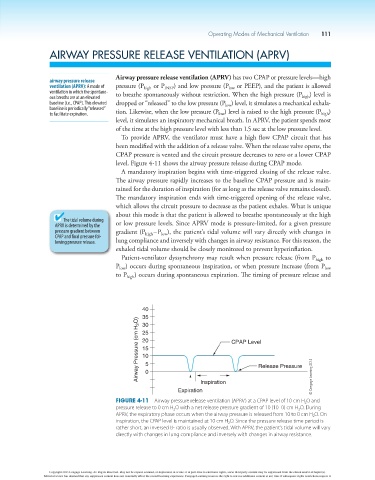
                                             level. Figure 4-11 shows the airway pressure release during CPAP mode.
                                               A mandatory inspiration begins with time-triggered closing of the release valve.
                                             The airway pressure rapidly increases to the baseline CPAP pressure and is main-
                                             tained for the duration of inspiration (for as long as the release valve remains closed).
                                             The mandatory inspiration ends with time-triggered opening of the release valve,
                                             which allows the circuit pressure to decrease as the patient exhales. What is unique
                                             about this mode is that the patient is allowed to breathe spontaneously at the high
                            The tidal volume during   or low pressure levels. Since APRV mode is pressure-limited, for a given pressure
                          APRV is determined by the
                          pressure gradient between   gradient (P  2P ), the patient’s tidal volume will vary directly with changes in
                          CPAP and final pressure fol-  high  low
                          lowing pressure release.  lung compliance and inversely with changes in airway resistance. For this reason, the
                                             exhaled tidal volume should be closely monitored to prevent hyperinflation.
                                               Patient-ventilator dyssynchrony may result when pressure release (from P high  to
                                             P ) occurs during spontaneous inspiration, or when pressure increase (from P
                                               low
                                                                                                                  low
                                             to P high ) occurs during spontaneous expiration. The timing of pressure release and


                                                      40
                                                      35
                                                     Airway Pressure (cm H 2 O)  20  CPAP Level Release Pressure
                                                      30
                                                      25

                                                      15
                                                      10
                                                       5
                                                       0


                                                                  Expiration Inspiration                     © Cengage Learning 2014
                                             Figure 4-11  Airway pressure release ventilation (APRV) at a CPAP level of 10 cm H 2 O and
                                             pressure release to 0 cm H 2 O with a net release pressure gradient of 10 (10–0) cm H 2 O. During
                                             APRV, the expiratory phase occurs when the airway pressure is released from 10 to 0 cm H 2 O. On
                                             inspiration, the CPAP level is maintained at 10 cm H 2 O. Since the pressure release time period is
                                             rather short, an inversed I:E ratio is usually observed. With APRV, the patient’s tidal volume will vary
                                             directly with changes in lung compliance and inversely with changes in airway resistance.


                        Copyright 2013 Cengage Learning. All Rights Reserved. May not be copied, scanned, or duplicated, in whole or in part. Due to electronic rights, some third party content may be suppressed from the eBook and/or eChapter(s).
                      Editorial review has deemed that any suppressed content does not materially affect the overall learning experience. Cengage Learning reserves the right to remove additional content at any time if subsequent rights restrictions require it.

