


Page 173 - Clinical Application of Mechanical Ventilation
P. 173
Special Airways for Ventilation  139


                        ESOphAGEAL-TRAChEAL COMBITuBE (ETC)


                                             The esophageal-tracheal combitube (ETC), also called pharyngealtracheal lumen
                        esophageal-tracheal combi-
                        tube (ETC): An airway  that may   airway and esophageal-tracheal airway, is a combination of esophageal and endotra-
                        be inserted into the esophagus or   cheal tube in one unit (e.g., Combitube™, by Kendall-Sheridan Corporation, Argyle,
                        trachea.
                                             NY). Due to its design, ventilation is possible when the ETC is inserted blindly ei-
                                             ther into the trachea or esophagus (Liao & Shalit, 1996). The ETC can be inserted
                                             easily by unskilled personnel (Yardy, Hancox & Strang, 1999), and it has been used
                            The ETC is inserted
                          blindly either into the trachea   successfully as an alternate artificial airway in patients outside the hospital (Blostein,
                          or esophagus.      Koestner & Hoak, 1998; Hoak & Koestner, 1997; Rumball & MacDonald, 1997).
                                             Ventilation is provided via a 15-mm airway connector at the proximal end of the ETC.
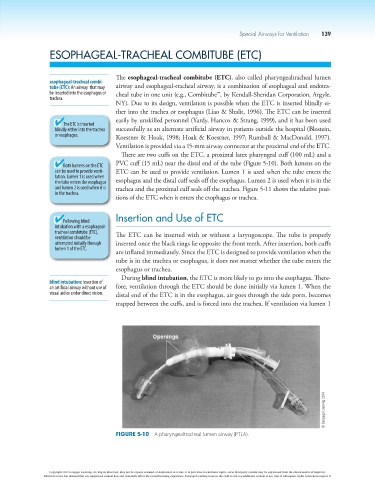
                                               There are two cuffs on the ETC, a proximal latex pharyngeal cuff (100 mL) and a
                                             PVC cuff (15 mL) near the distal end of the tube (Figure 5-10). Both lumens on the
                            Both lumens on the ETC
                          can be used to provide venti-  ETC can be used to provide ventilation. Lumen 1 is used when the tube enters the
                          lation. Lumen 1 is used when
                          the tube enters the esophagus   esophagus and the distal cuff seals off the esophagus. Lumen 2 is used when it is in the
                          and lumen 2 is used when it is   trachea and the proximal cuff seals off the trachea. Figure 5-11 shows the relative posi-
                          in the trachea.
                                             tions of the ETC when it enters the esophagus or trachea.

                                             Insertion and use of ETC
                            Following blind
                          intubation with a esophageal-
                          tracheal combitube (ETC),   The ETC can be inserted with or without a laryngoscope. The tube is properly
                          ventilation should be
                          attempted initially through   inserted once the black rings lie opposite the front teeth. After insertion, both cuffs
                          lumen 1 of the ETC.
                                             are inflated immediately. Since the ETC is designed to provide ventilation when the
                                             tube is in the trachea or esophagus, it does not matter whether the tube enters the
                                             esophagus or trachea.
                                               During blind intubation, the ETC is more likely to go into the esophagus. There-
                        blind intubation: Insertion of
                        an artificial airway without use of   fore, ventilation through the ETC should be done initially via lumen 1. When the
                        visual aid or under direct vision.  distal end of the ETC is in the esophagus, air goes through the side ports, becomes
                                             trapped between the cuffs, and is forced into the trachea. If ventilation via lumen 1


                                                                                                                  © Cengage Learning 2014


                                             Figure 5-10  A pharyngealtracheal lumen airway (PTLA).


                        Copyright 2013 Cengage Learning. All Rights Reserved. May not be copied, scanned, or duplicated, in whole or in part. Due to electronic rights, some third party content may be suppressed from the eBook and/or eChapter(s).
                      Editorial review has deemed that any suppressed content does not materially affect the overall learning experience. Cengage Learning reserves the right to remove additional content at any time if subsequent rights restrictions require it.

