


Page 177 - Clinical Application of Mechanical Ventilation
P. 177
Special Airways for Ventilation  143


                                               With each breath, the tube is advanced into the trachea until the bronchial seg-
                                             ment plugs the bronchus. The endpoint signs are (1) resistance to advancement
                                             (even with low compliance lungs), (2) unilateral ventilation by observation and
                                             auscultation, and (3) reduction in compliance (e.g.,  cPIP in volume-controlled
                                             ventilation). At this point, the tube is about 2.5 to 3 cm (bronchial cuff length plus
                                             1 cm) from its final position.
                                               Once the bronchial plugging point has been identified, the bronchial cuff is de-
                                             flated and the tube is inserted another 2.5 to 3 cm (bronchial cuff length plus 1 cm).
                                             The final bronchial cuff volume needed to seal should be small, about 1 to 2 mL.
                                             The patient connection is now changed to the tracheal connection. The tracheal cuff
                                             is inflated until a seal is made in the trachea. Proper positioning of the DLT can be
                            Proper positioning of   verified by auscultation or fiberoptic bronchoscopy (Klein et al., 1998).
                         the DLT can be verified by
                         auscultation or fiberoptic   If the left-sided tube goes right, turning the head 90º so that the chin is on the
                         bronchoscopy.
                                             right shoulder and rotating the tube on its axis to restore the bronchial tube to
                                             point laterally to the left can usually achieve insertion into the left main bronchus
                                             (Russell, 2004).


                                             Complications of DLT


                                             Use of DLTs may lead to airway injuries (Campos et al., 2000), and the most
                            The most severe form of   severe form of airway injuries is airway rupture. The incidence of airway rupture is
                          airway injuries caused by DLTs
                          is airway rupture.  higher when large and medium-sized red rubber DLTs are used. In contrast, small
                                             polyvinyl-chloride (PVC) DLTs have been associated with airway rupture (Akhtar,
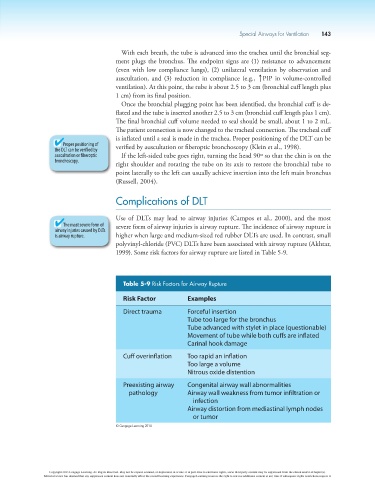
                                             1999). Some risk factors for airway rupture are listed in Table 5-9.


                                                Table 5-9 Risk Factors for Airway Rupture

                                                Risk Factor          Examples

                                                Direct trauma        Forceful insertion
                                                                     Tube too large for the bronchus
                                                                     Tube advanced with stylet in place (questionable)
                                                                     Movement of tube while both cuffs are inflated
                                                                     Carinal hook damage

                                                Cuff overinflation   Too rapid an inflation
                                                                     Too large a volume
                                                                     Nitrous oxide distention

                                                Preexisting airway   Congenital airway wall abnormalities
                                                  pathology          Airway wall weakness from tumor infiltration or
                                                                       infection
                                                                     Airway distortion from mediastinal lymph nodes
                                                                       or tumor
                                             © Cengage Learning 2014


                        Copyright 2013 Cengage Learning. All Rights Reserved. May not be copied, scanned, or duplicated, in whole or in part. Due to electronic rights, some third party content may be suppressed from the eBook and/or eChapter(s).
                      Editorial review has deemed that any suppressed content does not materially affect the overall learning experience. Cengage Learning reserves the right to remove additional content at any time if subsequent rights restrictions require it.

