


Page 174 - Clinical Application of Mechanical Ventilation
P. 174
140    Chapter 5


                                                                                           No. 1
                                                   No. 1                                  No. 2
                                                  No. 2


                                                                                                               © Cengage Learning 2014


                                                          A                                 B

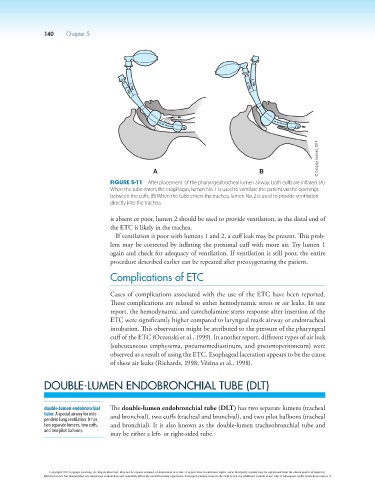
                                            Figure 5-11  After placement  of the pharyngealtracheal lumen airway, both cuffs are inflated. (A)
                                            When the tube enters the esophagus, lumen No. 1 is used to ventilate the patient via the openings
                                            between the cuffs. (B) When the tube enters the trachea, lumen No. 2 is used to provide ventilation
                                            directly into the trachea.

                                            is absent or poor, lumen 2 should be used to provide ventilation, as the distal end of
                                            the ETC is likely in the trachea.
                                             If ventilation is poor with lumens 1 and 2, a cuff leak may be present. This prob-
                                            lem may be corrected by inflating the proximal cuff with more air. Try lumen 1
                                            again and check for adequacy of ventilation. If ventilation is still poor, the entire
                                            procedure described earlier can be repeated after preoxygenating the patient.
                                            Complications of ETC


                                            Cases of complications associated with the use of the ETC have been reported.
                                            These complications are related to either hemodynamic stress or air leaks. In one
                                            report, the hemodynamic and catecholamine stress response after insertion of the
                                            ETC were significantly higher compared to laryngeal mask airway or endotracheal
                                            intubation. This observation might be attributed to the pressure of the pharyngeal
                                            cuff of the ETC (Oczenski et al., 1999). In another report, different types of air leak
                                            (subcutaneous emphysema, pneumomediastinum, and pneumoperitoneum) were
                                            observed as a result of using the ETC. Esophageal laceration appears to be the cause
                                            of these air leaks (Richards, 1998; Vézina et al., 1998).


                      DOuBLE-LuMEN ENDOBRONChIAL TuBE (DLT)


                      double-lumen endobronchial   The double-lumen endobronchial tube (DLT) has two separate lumens (tracheal
                      tube: A special airway for inde-  and bronchial), two cuffs (tracheal and bronchial), and two pilot balloons (tracheal
                      pendent lung ventilation. It has
                      two separate lumens, two cuffs,   and bronchial). It is also known as the double-lumen tracheobronchial tube and
                      and two pilot balloons.
                                            may be either a left- or right-sided tube.


                        Copyright 2013 Cengage Learning. All Rights Reserved. May not be copied, scanned, or duplicated, in whole or in part. Due to electronic rights, some third party content may be suppressed from the eBook and/or eChapter(s).
                      Editorial review has deemed that any suppressed content does not materially affect the overall learning experience. Cengage Learning reserves the right to remove additional content at any time if subsequent rights restrictions require it.

