


Page 268 - Clinical Application of Mechanical Ventilation
P. 268
234    Chapter 8


                      SUMMARY


                                            Initiation of mechanical ventilation requires many decisions, ranging from the mode of
                                            ventilation to the level of PEEP. Nevertheless, this process can be simplified by follow-
                                            ing a set of established guidelines. Under most clinical conditions, the initial settings
                                            on the ventilator will satisfy the immediate requirement for most patients.
                                             It is essential to remember that the initial settings are just that; subsequent changes
                                            to  these  settings  must  be  made  based  on  the  ever-changing  condition  of  the  pa-
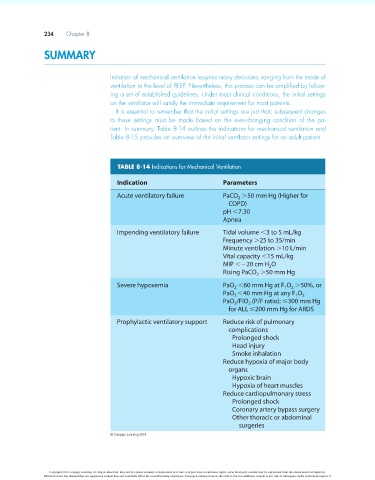
                                            tient. In summary, Table 8-14 outlines the indications for mechanical ventilation and
                                            Table 8-15 provides an overview of the initial ventilator settings for an adult patient.


                                              TABLE 8-14 Indications for Mechanical Ventilation

                                              Indication                        Parameters

                                              Acute	ventilatory	failure         PaCO 	.50	mm	Hg	(Higher	for
                                                                                     2
                                                                                  COPD)
                                                                                pH	,7.30
                                                                                Apnea

                                              Impending	ventilatory	failure     Tidal	volume	,3	to	5	mL/kg
                                                                                Frequency	.25	to	35/min
                                                                                Minute	ventilation	.10	L/min
                                                                                Vital	capacity	,15	mL/kg
                                                                                MIP	,220	cm	H O
                                                                                               2
                                                                                Rising	PaCO 	.50	mm	Hg
                                                                                           2
                                              Severe	hypoxemia                  PaO 	,60	mm	Hg	at	F O 	.50%,	or
                                                                                    2
                                                                                                       2
                                                                                                    1
                                                                                PaO ,40	mm	Hg	at	any	F O  2
                                                                                    2
                                                                                                        1
                                                                                PaO /FIO 	(P/F	ratio):	≤300	mm	Hg
                                                                                         2
                                                                                    2
                                                                                  for	ALI,	≤200	mm	Hg	for	ARDS
                                              Prophylactic	ventilatory	support  Reduce	risk	of	pulmonary
                                                                                  complications
                                                                                   Prolonged	shock
                                                                                   Head	injury
                                                                                   Smoke	inhalation
                                                                                Reduce	hypoxia	of	major	body
                                                                                  organs
                                                                                   Hypoxic	brain
                                                                                   Hypoxia	of	heart	muscles
                                                                                Reduce	cardiopulmonary	stress
                                                                                   Prolonged	shock
                                                                                   Coronary	artery	bypass	surgery
                                                                                   Other	thoracic	or	abdominal
                                                                                      surgeries
                                            © Cengage Learning 2014


                        Copyright 2013 Cengage Learning. All Rights Reserved. May not be copied, scanned, or duplicated, in whole or in part. Due to electronic rights, some third party content may be suppressed from the eBook and/or eChapter(s).
                      Editorial review has deemed that any suppressed content does not materially affect the overall learning experience. Cengage Learning reserves the right to remove additional content at any time if subsequent rights restrictions require it.

